Construction’s next chapter: Challenges, demand and opportunity.
Key takeaways:
- Construction companies face rising costs and labor pressure as material prices, supply chain fragility and workforce shortages continue to strain margins across the industry.
- Demand remains resilient as strong backlog levels, data center expansion and modular construction create opportunities despite market uncertainty.
- Risk management and new technologies strengthen stability through better contracting practices, cybersecurity focus, alternative materials and emerging tools that improve safety and efficiency.
Amid opportunities and questions, the U.S. construction industry continues to evolve in dynamic but sometimes challenging ways.
The first half of the 2020s was a study in contrasts for contractors. As the country and construction industry emerged from the slowdown and economic tumult caused by the COVID-19 pandemic, supply chain disruptions caused costs to soar. Labor shortages sapped the workforce. As a result, many outfits expressed concerns that profits would slip in the near-term, according to Associated Builders and Contractors opens in a new window.
Yet despite those headwinds — real and perceived — the U.S. construction industry remained strong in the first half of the decade, especially when compared with other countries. A similar dichotomy exists as the second half begins.
Driven primarily by iron and steel, costs continued their stubborn rise opens in a new window in late summer 2025, up 2.3% over the previous year. Inputs to commercial and healthcare construction saw the highest increases, with both jumping roughly 3.5% from the same time in 2024. It’s possible that U.S. trade policy and rising tariffs are contributing factors, but it may be too soon to precisely measure their impact.
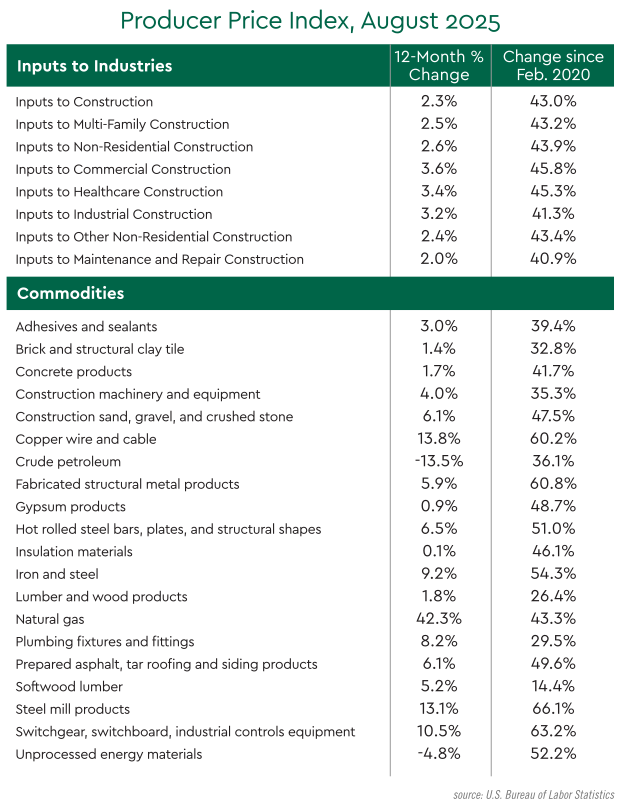
Figure 1
View PDF of Figure 1 PDF opens in a new window[PDF] footnote PDF video transcript
However, perception is another matter. Nearly half of construction firm executives who responded to a survey by Autodesk opens in a new window[PDF] classify their supply chains as “fragile due to geopolitical tensions,” a figure that continues to rise. Options for responding to supply chain challenges include material substitution (including using cost-effective alternatives in place of traditional materials), vertical integration and domestic sourcing, and supplier diversification to enhance resilience.
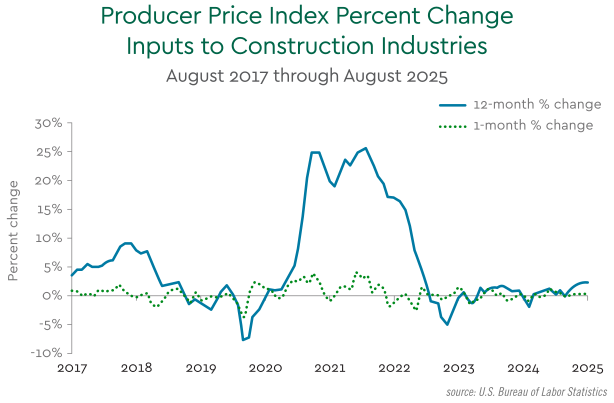
Figure 2
View PDF of Figure 2 PDF opens in a new window[PDF] footnote PDF video transcript
Though the residential construction sector remained steady in 2025, it was still down considerably from the previous year. In particular, housing starts and permits were off nearly 7% opens in a new window[PDF] compared with 2024, due in large part to increased labor and materials costs.
Uncertainties aside, though, several bright spots offer an indication of — if not substantial growth — an overall ability to endure this current slowdown.
The Associated Builders and Contractors backlog indicator opens in a new window, which reflects the work that commercial and industrial contractors expect to have in the months ahead, has remained relatively strong. As of September, the indicator sat at 8.5 months, just a tick down from the same time in 2024 and only slightly off from a high of 9.3 months in July 2023. In fact, the backlog has hovered around eight to nine months since the pandemic.
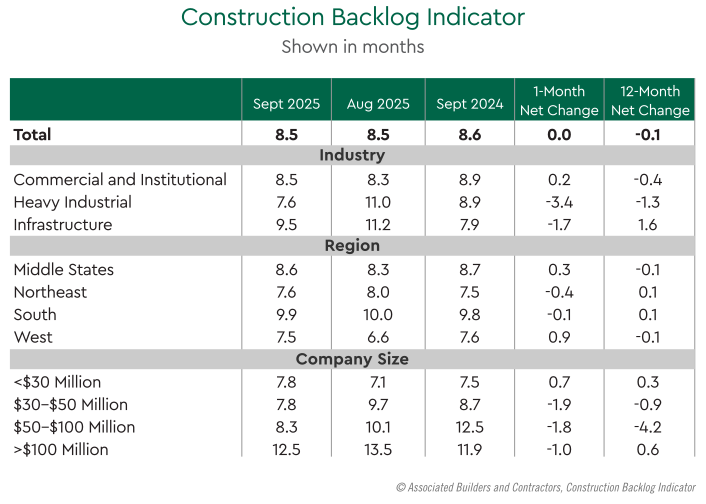
Figure 3
View PDF of Figure 3 PDF opens in a new window[PDF] footnote PDF video transcript
Similarly, ConstructConnect's project stress index opens in a new window, which tracks delayed bid dates, on-hold projects, and abandonments in preconstruction, declined steadily in the second half of 2025. Though the data was noisy from month to month, with the number of abandonments and on-hold projects routinely bouncing up and down, the index appears to be trending in a more positive direction for the industry.
Perhaps most telling is the fact that, in the face of the challenges that continue to weigh on the industry, contractors are generally optimistic about the future. According to the Associated Builders and Contractors confidence index opens in a new window — which tracks members’ expectations for sales, profit margins and staffing levels — contractors foresee modest growth ahead.
Lower rates and rising labor pressure.
One reason for companies’ optimism may be the Federal Reserve Board’s slow but continued easing of interest rates. Though inflation stubbornly remained between 2.5% and 3% for much of 2025 — well above the target of 2% — the Fed lowered interest rates three times in 2025. Those cuts, paired with two in 2024, brought the rate down two points from its 10-year high of 5.5% in early 2024.
In announcing the second cut opens in a new window in October 2025, the Fed pointed specifically to its ongoing concerns about the labor market, an issue that U.S. construction firms are all too familiar with. Job openings in the construction industry peaked in December 2023 opens in a new window at 449,000. Despite sales softening since then, construction companies continue to struggle to find skilled labor, which has increased operational costs, primarily through project delays. A 2025 survey of nearly 1,400 firms conducted by the Associated General Contractors of America (AGC) and the National Center for Construction Education and Research (NCCER) found that 92% of contractors struggle to fill open positions. Nearly half report experiencing job delays as a result.
At least some of that may have to do with the Department of Homeland Security’s dramatically increased immigration enforcement practices. The American Business Immigration Coalition estimates that immigrants account for nearly one-third opens in a new window of the national construction workforce, and more than 1.5 million undocumented immigrants work in the industry. So perhaps not surprisingly, the AGC and NCCER’s survey also found that 28% of respondents report they were affected directly or indirectly by immigration enforcement activities in the first half of 2025. Specifically, 5% report a jobsite or offsite was visited by immigration agents. Ten percent say workers left or failed to appear because of actual or rumored immigration actions, and 20% report subcontractors lost workers.
As falling interest rates begin to push up demand for services, the need for workers will only increase. In fact, Associated Builders and Contractors predict that the industry will need to add nearly 500,000 workers opens in a new window in 2026.
The rising cost of college tuition opens in a new window at both public and private institutions that is driving young people to look for alternative career paths should be a boon for the construction trades. However, the industry has so far failed to capitalize on the shift, and ironically, the most effective solution may not lie in reaching out directly to the potential future tradespeople themselves, but to their parents.
After decades of the perception that a job in construction is somehow lesser than one in the white-collar workforce, today’s adults are coming around to the value opens in a new window[PDF] of construction careers. And savvy outfits capable of highlighting the benefits of the trades — job security, room for career growth, and opportunities for formal training, among others — stand to make significant inroads with adults who can in turn influence their children’s choices.
That said, connecting with young people on their terms will always be critical to improving their perception of a career in construction. Social media, particularly TikTok, is proving useful for those who are comfortable with both short-form video and the unique nuances of influencer culture. TikTokers like Chelsea Fenton (@thatunionlaborer), who works in concrete, and Andrew Brown (@andrewbrowntrades), an advocate for the construction trades, have built large followings through authentic messages that speak directly to young people who are either in the industry or considering it.
Slow payments tightening the screws on subcontractors.
Rising material costs, shifting tariff policies, unpredictable supply chains, and the ongoing labor shortage will no doubt continue to squeeze contractors’ and subcontractors’ already-slim profit margins, with the latter shouldering much of the burden.
The 2025 National Subcontractor Market Report opens in a new window[PDF] — a survey of more than 800 construction professionals conducted by lender Billd — found that subs typically wait 56 days for payment. That’s 25% more than the 45 days sales outstanding (DSO) opens in a new window that construction cost accountants recommend for maintaining strong cash flow and good credit management. It has become common practice for general contractors to structure contracts such that payment isn’t due to subcontractors until the general contractor has been paid. As end users take longer to pay, however, that approach only serves to extend the pain and exacerbate the issue.
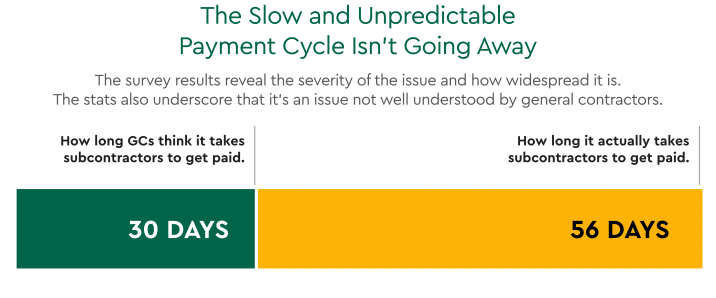
Figure 4
View PDF of Figure 4 PDF opens in a new window[PDF] footnote PDF video transcript
And the impacts of slow payments extend well beyond a subcontractor’s bottom line to affect the construction industry at large. The delays lead to increased financing costs, missed deadlines, higher bids, and a growing reluctance from subcontractors to take on new work. As a result, more often than not, subcontractors now take a general contractor’s payment history into account before deciding whether to bid on a project — and when they do bid, they’re charging more opens in a new window.
Firms feeling pinched by late payments do have options, though. Using a variety of working capital options, including cash, supplier terms, bank lines of credit, credit cards, and construction-specific financing options, helps create a stronger safety net. Construction-specific financing is especially important because traditional financing options have limits that don’t meet the needs of construction businesses.
Strengthening resilience in an unpredictable market.
Taking proactive steps to manage risk remains critical to navigating the current business environment. Setting aside some of the factors that are harder to control, such as the economy or tariffs, contractors should focus on a few key areas in the coming year to strengthen their ability to weather the unpredictability.
One is managing bidding and contracting risk to ensure project viability and prevent cost overruns and scheduling delays. More than 40% of contractors surveyed for Marsh’s global construction risk review 2025 opens in a new window reported that they conduct more thorough prequalification and risk assessments of subcontractors before bidding. Roughly the same amount have begun taking a more aggressive approach to negotiating contract terms in order to transfer or mitigate risks. Perhaps most surprising, though, nearly a third have opted out of bidding on high-risk projects altogether.
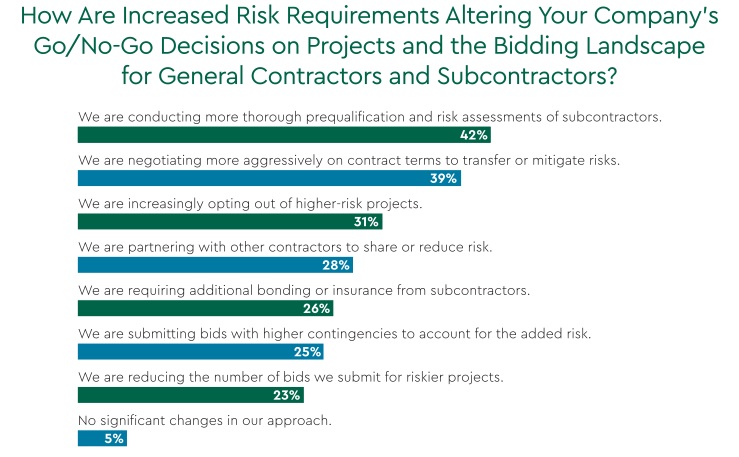
Figure 5
View PDF of Figure 5 PDF opens in a new window[PDF] footnote PDF video transcript
Regardless, developing a well-defined capital management strategy can mitigate risks by helping contractors understand how to maximize capacity and deploy resources efficiently, including negotiating progressive and partial bonding.
Cybersecurity should continue to be a priority as well. More than two in five opens in a new window contractors report experiencing increases in phishing, data breaches and ransomware attacks in the previous year. And the trend shows no signs of abating, in part because the rise in adoption of mobile apps, cloud-based project management systems, and data integration platforms increases vulnerability. Developing a team within the company to manage cybersecurity, training employees on good cyber hygiene, and continually reinforcing stronger cyber habits with business partners are all important steps.
Though not cited as often as labor shortages or supply chain disruptions, climate change can still have a significant impact on the profitability of construction projects. In fact, a study conducted by the Air Force Institute of Technology opens in a new window found that weather delays approximately 45% of construction projects worldwide each year, costing owners and contractors billions of dollars in lost revenue. And if more isn’t done to mitigate the factors that contribute to climate change, that number will continue to rise as weather becomes even more severe.
No single industry, let alone company, can turn the tide on climate change. However, construction companies should integrate risk modeling throughout the project life cycle to identify potential risks that could cause delays and damage while promoting resilience against climate-related challenges. By analyzing historical climate data and future projections, companies can develop strategies to minimize vulnerabilities and enhance project resilience.
On the other side of the equation, the constantly evolving risk environment is having dramatic effects on the way insurers cover construction projects. Unlike in the past, when underwriters were more likely to apply a one-size-fits-all model to contractors across the industry, today’s market is much more segmented based on trade, location and risk profile. To adapt and keep their premiums low, contractors can more closely scrutinize their project timelines, cost projections and overall risk, while also working to incorporate risk mitigation strategies from the project’s start.
Technology driving a safer jobsite.
Construction comes with more than just business risks. On even the most well-managed jobsites, workers are exposed to many potential physical hazards, from falls to electrocutions, and injuries and deaths have remained high for more than a decade. The construction industry accounted for 1,075 workplace fatalities in 2023 opens in a new window, the most recent year for which data is available. That’s the highest number of annual deaths in construction since 2011.
However, firms have a range of new devices and technologies from which to choose for providing their workers with a safer workplace.
- Lone worker monitoring: Wearable devices, standalone or complementary applications, or integrated software platforms designed to monitor, protect, and manage workers who perform activities in isolation or without close supervision. These include downed-worker devices that can detect falls or impacts and alert other employees tasked with monitoring the isolated worker.
- Virtual and augmented reality: Technology that allows workers to experience or interact with environments more safely with a variety of devices. Virtual reality (VR), which immerses the user in a realistic, simulated environment via a headset, is ideal for safety training where workers can identify and respond to hazards. Augmented reality (AR) overlays extra information onto a real-world environment through mobile devices, camera displays or video feeds, offering insights that can aid workers in assessing situations.
- Vital signs monitors: Wearable devices that can track workers’ well-being to help them maintain safety on the job. Though compact and unobtrusive, they can measure heart rate and body temperature and alert workers when they’re losing fluids and not drinking enough water in hot environments.
- Location geofencing: A mix of location-based data sources, including GPS, radio frequency identification (RFID), and Wi-Fi or cellular data, to create virtual “barriers” around a geographic area. When a location-enabled device crosses the geofenced boundary, a series of predetermined actions or responses is triggered, including logging the event for future analysis, alerting workers and supervisors of potential hazards, or disabling machinery or vehicles.
- Proximity sensors: Monitoring devices that detect objects within a set boundary using infrared, radio frequencies, Bluetooth or specialized lasers. When a person or equipment enters the sensor’s range, the activity is recorded and triggers a warning.
Advances in technology continue to offer firms new options for improving safety. But tried-and-true approaches are still just as important. Falls, slips and trips accounted for nearly 40% of construction workplace fatalities in 2023, and the vast majority of falls were from less than 30 feet. Developing and maintaining a culture that prioritizes safety over speed and conscientiousness over corner-cutting can reduce accidents by signaling to employees that their well-being comes before profit.
The data center boom reshaping the industry.
One significant cause for optimism within the industry is the sustained — and now surging — strength of data center construction. Driven by ongoing demand for cloud computing infrastructure as well as an explosion in artificial intelligence investment, McKinsey & Company estimates that companies will pour a staggering $2.6 trillion into data center construction opens in a new window by 2030.
A host of variables could cause that number to vary, from the general population’s adoption of AI and chip manufacturers’ ability to meet the industry’s demands to the availability of real estate and energy. However, years of data center investment in northern Virginia have produced a trove of insights into what their development can mean for the construction industry. The area is home to nearly 600 data centers, or 13% of the world’s operational capacity and 25% of the Americas’, including roughly 150 of the largest kind, known as hyperscale data centers. And there are plans for 70 more in the coming years.
In 2023, the Virginia Joint Legislative Audit and Review Commission conducted an analysis opens in a new window of the data center industry’s impacts on the state’s economy and found that while running one of these structures requires a modest staff, building one is something else entirely: Construction can last upwards of 18 months and require as many as 1,500 workers from various construction-related industries at its peak. Overall, the data center industry is estimated to have contributed 74,000 jobs and $5.5 billion in labor income, with most of the economic benefits coming from the construction phase.
Though markets like Virginia, the Pacific Northwest, and Northern California will continue to be hotspots for this activity, McKinsey & Company predicts the projected demands — particularly for hyperscale data centers — will force developers to spread out into more remote locations where power is abundant and grids are less constrained. In particular, regions like southern Texas, Las Vegas and Salt Lake City, among others, will be key areas of expansion in the coming years.
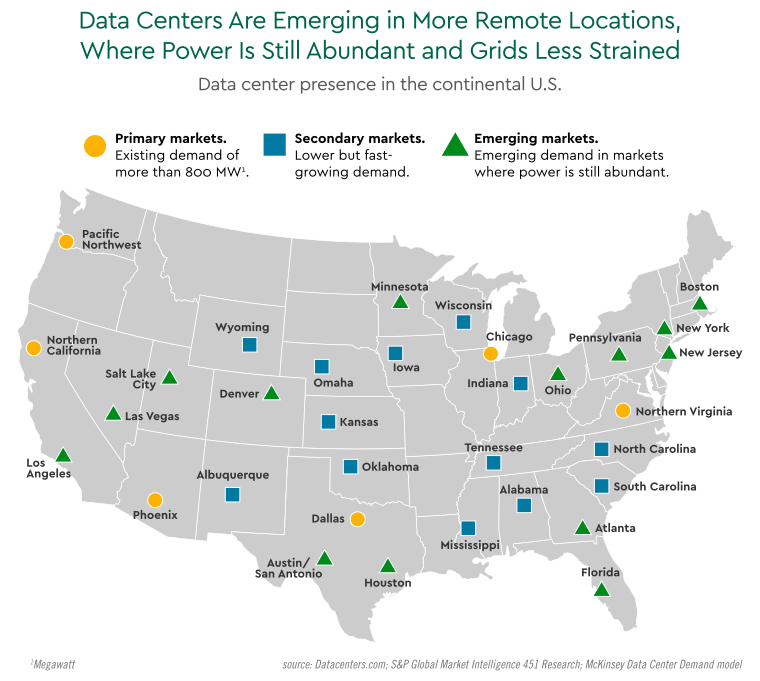
Figure 6
View PDF of Figure 6 PDF opens in a new window[PDF] footnote PDF video transcript
Not only will the AI and cloud computing boom require significant investment in data center construction, but the massive amounts of energy that both industries consume will also spur an unprecedented build-out of new energy capacity. In a recent report opens in a new window, the Electric Power Research Institute and Epoch AI predict that nationwide energy demand for AI-related products and services could explode from 5GW currently to 50GW by 2030.
The AI impact.
As is the case in almost every other industry, AI is also poised to change how construction firms work — though to what degree and how quickly are still up for debate.
In theory, incorporating AI into day-to-day operations could have many advantages. Construction produces a tremendous amount of data every day, including cost estimates, project schedules, safety reports and material usage. Gaining truly usable insights from that data, however, is challenging and time-consuming for anyone, much less someone managing multiple crews across dozens of jobsites. Well-designed algorithms, however, can find patterns in that data and provide actionable insights for increasing efficiency and addressing challenges in everything from cost estimating and site safety to automating contract review.
While Zacua Ventures, a VC firm focused on the construction industry, found in early 2025 that more than half of investors planned to increase spending on AI opens in a new window over the previous year, contractors themselves appear to be taking a more measured approach to implementing the technology into their daily operations.
In general, contractors agree that AI could be valuable for streamlining several work processes, especially amid the various factors like labor shortages and rising costs that are constraining the industry. A survey of more than 2,200 companies worldwide opens in a new window conducted by the Royal Institution of Chartered Surveyors (RICS) found that a majority of respondents believe AI will be moderately or highly significant in improving progress monitoring, project scheduling, and risk and cost management, among other things.
However, adoption rates don’t align with those opinions. Nearly half of respondents reported having yet to implement AI, while another third are only in the early phases, suggesting that the industry recognizes the technology’s potential benefits but remains uncertain about scalability, integration or business value.
In fact, very few companies appear ready to make the AI leap anytime soon. RICS’s survey also found that just under a third of respondents had neither the capability nor the plans to integrate AI into their workflows, and another 45% were only in early phases of discussing how it might be implemented.
Before AI can fully take root in the traditionally risk-averse construction industry, it’s likely that companies will need more confidence that they have enough data to make it a worthwhile investment, that their data will remain secure, and that their workforce has the technical know-how to use AI to its fullest capabilities.
Mergers and acquisitions momentum accelerating into 2026.
Mergers and acquisitions activity in the construction industry remain significantly up, according to Capstone Partners’ 2025 Construction Services Market Update opens in a new window. Driven primarily by the data center boom and pent-up demand for new residential construction, transactions increased for the third year in a row — and by a wide margin. Those tailwinds contributed to a 33.8% jump in deals year over year, with companies ramping up acquisitions of businesses that expand market share or broaden service capabilities across key end markets.
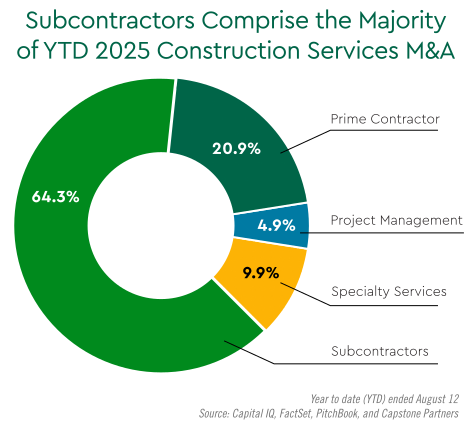
Figure 7
View PDF of Figure 7 PDF opens in a new window[PDF] footnote PDF video transcript
As in previous years, private equity accounted for the majority of M&A deals in 2025. And its share is increasing at a substantial clip: As of the summer of 2025, private equity M&A deals were up 66.7% over the same time in 2024, with most involving subcontractors. Capstone points to the segment’s fragmented market, recession-resilient services, and easily scalable operations as drivers of private equity’s appetite for subcontractors, predicting that the trend will likely persist in the near-term as firms roll up businesses either horizontally or vertically to expand market share or bolster end-market service capabilities.
Some of the largest recent deals reflect recent trends in the industry:
- San Francisco–based commercial builder Webcor acquired Phoenix’s GCON opens in a new window, a construction management firm with significant experience in data center builds. The deal will allow the former to expand its reach into this burgeoning market, while the latter now has the financial footing to take on larger projects.
- With water security a growing concern in the Southwest, San Antonio–based Zachry Construction acquired Crescent Constructors opens in a new window, expanded its capabilities in the water infrastructure sector.
- Civil contractor and road builder Granite Construction opens in a new window acquired its sixth company in less than two years as part of an aggressive strategy to expand horizontally and consolidate businesses that supply the materials and services it relies on.
Additionally, Deloitte suggests that in the new year M&A that strengthens digital capabilities will be integral to growth and competitiveness, along with maintaining liquidity, managing debt wisely, and optimizing legislative incentives.
The case for modular in a strained market.
One modest — but growing — sector to keep an eye on is the modular construction industry, which accounted for just over 5% of the overall construction industry in 2024.
Modular construction has a handful of characteristics that make it attractive in the current economic environment and account for the Modular Building Institute (MBI) and FMI Consulting’s opens in a new window prediction that the industry will grow at a compound annual growth rate of 4.5% over the next five years to $25.4 billion, outpacing the overall construction sector by 1.3%.
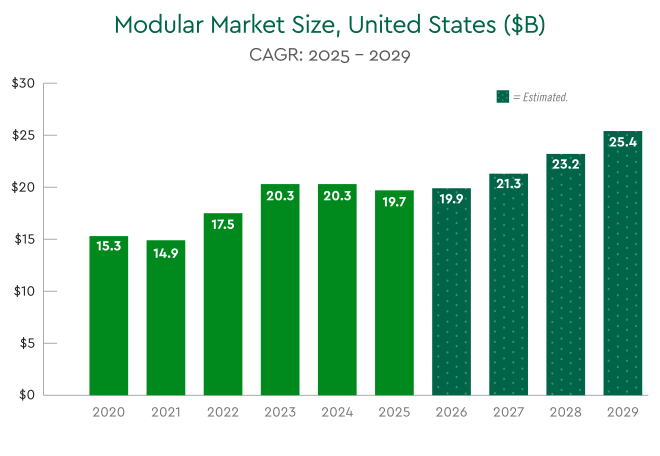
Figure 8
View PDF of Figure 8 PDF opens in a new window[PDF] footnote PDF video transcript
Chief among those characteristics is lower cost. As the MBI and FMI report points out, a study from the University of Nebraska’s Durham School of Architectural Engineering and Construction found that construction costs for site-built projects averaged $251 per square foot. The cost for modular projects averaged $243 per square foot, approximately 4% less than site-built construction. A variety of factors, including lower labor costs and dramatically fewer change orders, contribute to those cost savings.
Because the vast majority of a modular construction project occurs indoors, it can also typically be completed much more quickly than a traditional site-built project. In fact, according to MBI, modular construction can accelerate timelines by anywhere from 20% to 50%.
Segments within the modular construction industry that are expected to see the biggest gains in the coming years are multifamily residential, office and lodging. Generally speaking, multifamily residential construction is primed for significant expansion if interest rates continue to ease. Thanks to its shorter production schedules and more cost-effective delivery methods amid labor shortages and rising material costs, modular is well-positioned to take advantage of that demand, particularly in the South, Mid-Atlantic and Mountain states. MBI and FMI predict that this modular segment is expected to grow to $11.3 billion by 2029 at a 4.7% compound annual growth rate, outpacing the overall construction industry by more than 6%.
Of course, the modular industry is not without its challenges. To be successful, firms must be willing to invest time in educating customers who may not be as familiar with modular construction, overcoming negative perceptions of quality and durability driven by historical association with low-quality temporary structures.
Sustainability moving from nice-to-have to necessity.
Another sector to keep an eye on in 2026: sustainable building. Long considered a nice-to-have, sustainability in construction is turning a corner in terms of perception within the industry. More than 60% opens in a new window of companies classify improving sustainability as a good short-term business decision according to a 2025 Autodesk survey, signaling that the practice is seen as good for business overall.
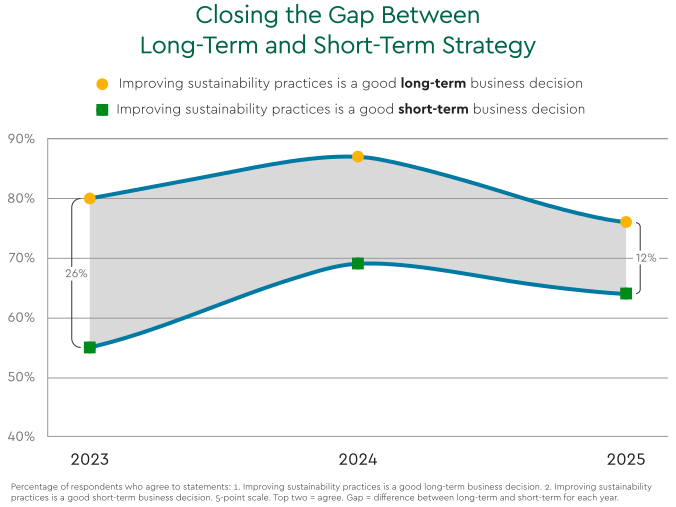
Figure 9
View PDF of Figure 9 PDF opens in a new window[PDF] footnote PDF video transcript
One of the most important aspects of incorporating sustainability — aside from educating customers on its importance and value — is rethinking what building materials to use. Materials include:
- Bendable concrete. Thanks to its strength (it’s 500 times more resistant to cracking than traditional concrete), ductility, and reduced reliance on coarse aggregate, this proven alternative can dramatically decrease the financial and environmental costs of buildings.
- Mass timber. Increasingly popular for roofs, floors, beams and columns, mass timber is created by mechanically bonding various types of softwood to form large, prefabricated wood components. Because it’s a viable alternative to steel and concrete, which have higher carbon footprints, the material has been shown to reduce a building’s global warming potential by nearly 27% opens in a new window.
- Bamboo. Thanks to its extreme flexibility, bamboo can be used for structural and decorative purposes. Its wide availability and minimal waste have made it increasingly popular of late.
- 3D-printed concrete. Using a special mix designed to flow through large gantry printers, this emerging technology allows for precise pours without forms, reducing waste and lowering costs.
- Mycelium. This vegetative structure of certain fungi is highly durable and resistant to mold, water and fire. When mixed with timber, sawdust and demolition waste, it can be formed into bricks that take the place of concrete and other building materials.
Beyond reducing a project’s carbon footprint, transitioning to alternative materials like these can have another even timelier benefit: weathering supply chain fluctuations and rising prices.
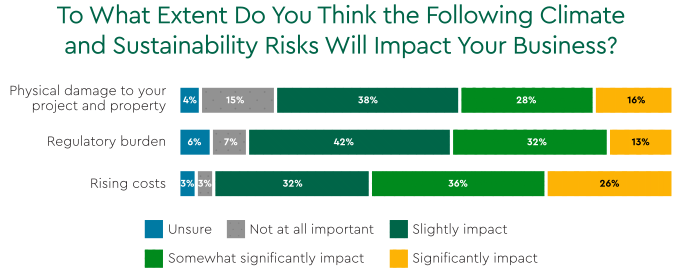
Figure 10
View PDF of Figure 10 PDF opens in a new window[PDF] footnote PDF video transcript
Why 2026 may be a turning point.
Perhaps the best word to describe the state of the construction industry in 2026 is “transitional.” Though demand for new construction — particularly housing — is strong, high material costs, shifting policies, and stubborn supply chain complications continue to hold the overall market in check.
Bright spots, such as the overwhelmingly strong demand for data centers, are helping to buoy the sector. But on balance, construction firms — both general contractors and subcontractors — would be wise to take advantage of opportunities to expand and diversify while managing risks and exploring emerging technologies.
Disclosures:
To view or print a PDF file, Acrobat® Reader® 9.5 or above is recommended. Download the latest version opens in a new window.
To send an email that contains confidential information, please visit the Secure Message Center where there are additional instructions about whether to use Secure Email or Online Banking messaging.