Building resilience: Manufacturing’s next phase of growth.
Key takeaways:
- U.S. manufacturers continue investing in facilities, automation and technology despite slower production growth, reflecting a focus on long-term competitiveness, productivity and operational resilience.
- Construction spending, particularly in semiconductor, electrical equipment, food processing and data center-related industries, remains elevated and continues to shape manufacturing capacity expansion.
- Workforce shortages, digital transformation and supply-chain resilience are influencing investment decisions, while regional manufacturing hubs attract new projects through infrastructure, talent and supplier networks.
The U.S. manufacturing industry continues to demonstrate resilience in a more complex economic environment. While manufacturing output has remained relatively steady and investment has moderated from recent highs, manufacturers continue to commit capital to facilities, technology and infrastructure that will support long-term competitiveness. Employment remains uneven as firms continue to navigate skilled labor shortages while investing in automation and productivity-enhancing technologies.
This report examines manufacturing through the lens of construction, capital investment and capacity expansion, focusing on demand, production, labor, orders and regional trends. It highlights four subindustries closely linked to facility spending and provides a grounded outlook for the coming months.
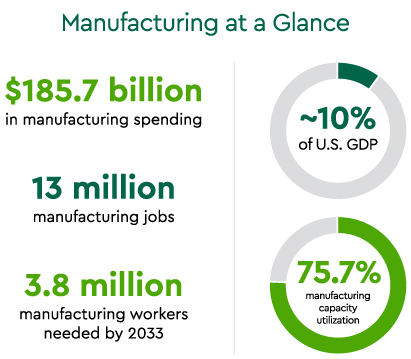
Figure 1
View PDF of Figure 1 PDF opens in a new window[PDF] footnote PDF video transcript
A new era of investment.
Manufacturing remains a cornerstone of the U.S. economy. According to the National Association of Manufacturers (NAM), the sector contributes roughly one-tenth of U.S. gross domestic product (GDP), supports approximately 13 million jobs opens in a new window and accounts for more than half of private-sector research and development spending. These fundamentals continue to underscore manufacturing’s role as both an economic driver and a catalyst for innovation.
Following the disruptions of the pandemic era (supply chain disruptions, volatile input costs and staffing shortages), the manufacturing sector has settled into a more measured trajectory. The focus has shifted from recovery to reinvestment. Manufacturers continue to modernize facilities, expand automation, strengthen digital capabilities and invest in technologies that improve long-term productivity and operational resilience. Although manufacturing construction spending has moderated from its recent peak, Federal Reserve data shows manufacturing capacity utilization at 75.7% in May 2026 opens in a new window, indicating that companies continue investing in long-lived assets even though existing facilities operate below their historical average utilization. Facility construction remains elevated relative to historical norms, although the pace of investment has moderated from its recent peak.
One of the clearest indicators of that long-term confidence is manufacturing-related construction. The latest U.S. Census Bureau data (released June 1, 2026) shows total manufacturing construction spending at a seasonally adjusted annual rate of $185.7 billion in April 2026 opens in a new window. Although this is below the record levels reached during the height of the recent semiconductor investment cycle, spending remains dramatically higher than pre-pandemic levels, reflecting ongoing investments in semiconductor fabrication, electrical equipment manufacturing, battery production, food processing facilities and other advanced industrial projects.
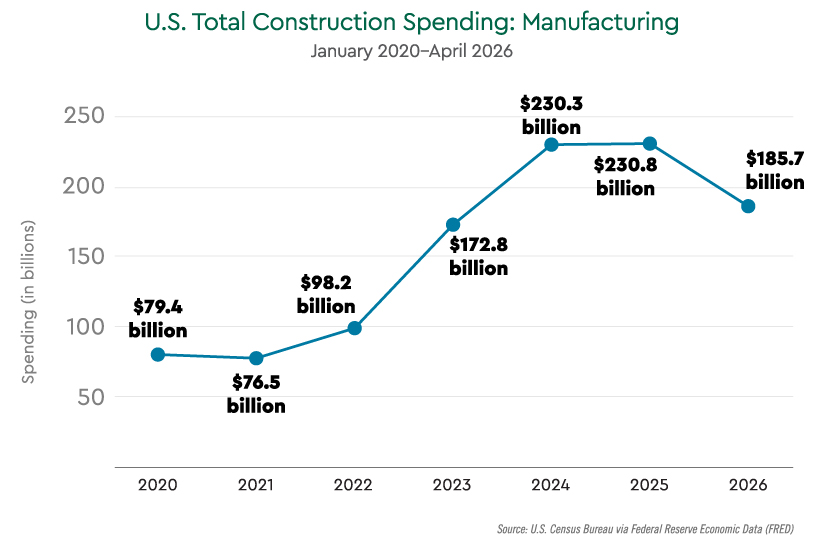
Figure 2
View PDF of Figure 2 PDF opens in a new window[PDF] footnote PDF video transcript
The 2026 economic backdrop.
Output and production.
Federal Reserve data indicates that manufacturing output has remained relatively steady through the first half of 2026, with production fluctuating modestly from month to month rather than following a sustained upward or downward trend. Growth has remained strongest in technology-related manufacturing, electrical equipment and selected capital goods, while other manufacturing segments continue to experience more measured activity.
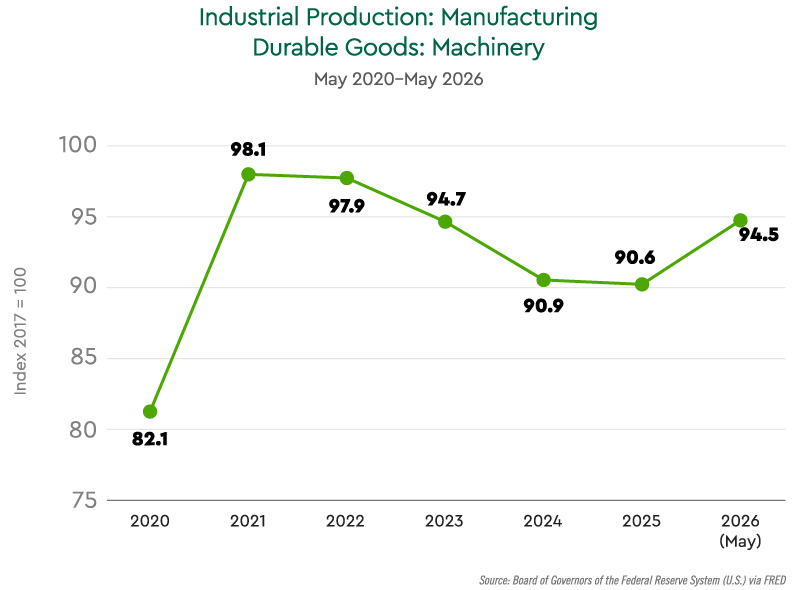
Figure 3
View PDF of Figure 3 PDF opens in a new window[PDF] footnote PDF video transcript
Demand and orders.
Manufacturing demand remains uneven across industries. Purchasing managers’ surveys indicate that while some sectors continue to experience softer order activity, demand tied to infrastructure, electrification, AI, energy modernization and industrial automation has remained comparatively resilient. Many manufacturers continue to manage inventories conservatively as they balance uncertain economic conditions with ongoing investment opportunities.
Durable goods data from the U.S. Census Bureau continues to show healthy backlogs in several capital-intensive industries, including industrial machinery, electrical equipment and transportation equipment. Although new orders have moderated from the exceptionally strong levels experienced during the post-pandemic recovery, existing project pipelines continue to support production schedules and long-term capital investment.
Replacement demand also remains an important source of stability. Manufacturers across food production, logistics, automotive and materials handling continue to replace aging equipment while modernizing facilities with more automated, energy-efficient technologies. These replacement cycles continue to support demand for machinery, electrical equipment, HVAC systems and process automation solutions.
Employment and labor.
Manufacturing employment has remained relatively stable, although hiring conditions vary by industry and region. Manufacturers consistently report difficulty recruiting skilled technicians, maintenance specialists and other highly specialized workers, even as overall employment growth has moderated.
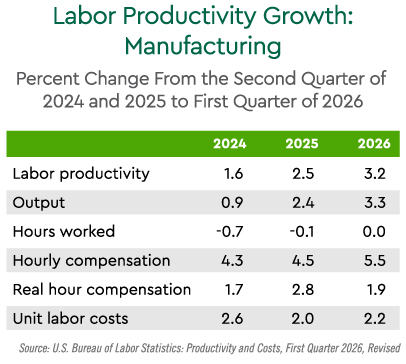
Figure 4
View PDF of Figure 4 PDF opens in a new window[PDF] footnote PDF video transcript
Long-term workforce challenges continue to shape investment decisions. The Manufacturing Institute and Deloitte opens in a new windowproject that manufacturers will need millions of additional workers over the coming decade, with a substantial share of those positions potentially remaining unfilled if current workforce trends continue. In response, manufacturers are expanding apprenticeships, workforce partnerships and technical training while increasing investments in automation and advanced manufacturing technologies.
Manufacturers also continue investing in technologies that improve productivity and operational efficiency. Robotics, predictive maintenance, digital manufacturing platforms and AI-enabled quality systems are helping companies maximize existing capacity while strengthening long-term competitiveness.
Construction and capacity.
Manufacturing construction is often viewed as a leading indicator of long-term business confidence because of the scale and duration of associated capital commitments. Although spending has moderated from the record levels reached during the recent semiconductor investment cycle, manufacturing construction opens in a new windowremains well above pre-pandemic levels, supported by ongoing investments in semiconductor fabrication, electrical equipment manufacturing, battery production, food processing facilities and advanced industrial projects.
Investment in AI infrastructure and hyperscale data centers continues to create demand for electrical equipment, cooling systems, backup power, networking infrastructure and specialized construction services. These projects are expanding opportunities throughout the broader manufacturing supply chain while reinforcing demand for advanced industrial facilities.
Taken together, these trends point to a manufacturing sector that continues investing in long-lived assets, albeit with a slower pace of production growth. Facility modernization, automation, infrastructure investment and technology adoption remain defining characteristics of the current manufacturing cycle, positioning companies to compete in an increasingly advanced industrial economy.
Four subindustries driving construction-linked growth.
Beneath the top-line numbers, four manufacturing segments stand out for their links to construction and capacity expansion: machinery, electrical equipment, food & beverage, and HVAC equipment. All four show substantial nominal growth since 2020 in Bureau of Economic Analysis (BEA) data and sit at the center of current facility-building trends.
Machinery manufacturing.
The most recent BEA industry accounts show that machinery manufacturing opens in a new windowgenerated about $208.6 billion in nominal value added in 2024, up from roughly $150.1 billion in 2020, an increase of about 39% over four years. In real terms, machinery manufacturing output in 2024 was roughly 5% above its 2020 level, reflecting continued long-term growth despite moderating from its 2021 peak.
More recent indicators suggest those gains have largely been sustained through the first half of 2026. Federal Reserve industrial production data shows machinery manufacturing continues to operate at relatively stable levels. Census data indicates that manufacturers continue to invest in equipment tied to infrastructure, automation, logistics and industrial modernization. Even though demand has become more selective, replacement cycles and long-term capital projects continue to support activity across much of the machinery sector.
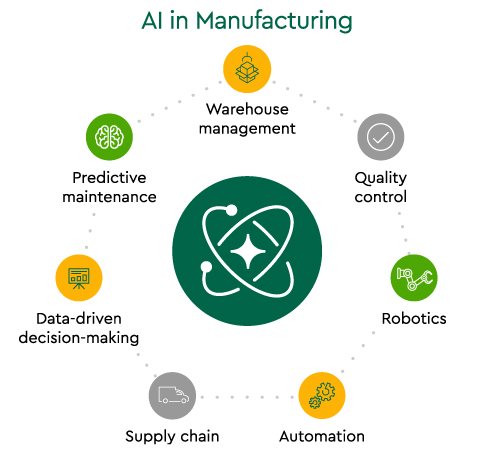
Figure 5
View PDF of Figure 5 PDF opens in a new window[PDF] footnote PDF video transcript
Growth remains broad-based across agricultural, construction, energy, industrial and material-handling equipment. Key demand drivers include the following:
- Agriculture and energy: Ongoing needs for high-horsepower tractors, combines, drilling rigs and related equipment, along with growing demand driven by data-center construction.
- Infrastructure and construction: Elevated public works and private construction spending, including grid, road, pipeline and port projects.
- Robotics and AI: Expanded use of automated material-handling systems, machine-tool upgrades and factory automation lines.
On the investment side, machinery-intensive projects, such as automated distribution centers and large process plants, require facilities with heavy-duty foundations, high-capacity power, craneways and extensive testing bays. These features are more prevalent in higher-value construction projects and long planning horizons, making machinery manufacturing a forerunner in multi-year capital commitments.
Electrical equipment manufacturing.
Electrical equipment, appliance and component manufacturing has posted similar nominal gains. BEA figures opens in a new windowshow value added rising from about $57.7 billion in 2020 to roughly $80.2 billion in 2024, an increase of nearly 39%. Real value added in this sector registered about $50.5 billion opens in a new windowin 2024, modestly above its level a year earlier and below its 2021 peak.
More recent data reinforces the sector's momentum. Continued investment in grid modernization, semiconductor fabrication, battery production and AI infrastructure has supported demand for transformers, switchgear, power distribution equipment and industrial controls. Manufacturing construction projects announced and underway during 2026 continue to create long-term opportunities for electrical equipment manufacturers despite a more measured pace of overall industrial growth.
This sector sits at the nexus of several long-term investment trends:
- Grid modernization and resilience: Utilities and grid operators are investing in transformers, switchgear, relays, storage and protection systems to harden networks, integrate renewables and support electrification.
- EV and battery facilities: New lithium-ion and next-generation battery plants require large volumes of power distribution and process control equipment.
- Data centers and AI: Large-scale data campuses opens in a new windowtied to cloud and AI workloads rely on uninterruptible power supply (UPS) systems, switchgear, substations and busway systems capable of supporting heavy continuous loads.
- Semiconductor fabs: Multi-billion-dollar fabs under construction in Arizona, Ohio, Texas and other states require extensive power distribution, backup and clean-power systems, providing long-tail orders for electrical manufacturers.
Bureau of Labor Statistics (BLS) data opens in a new windowshows employment in electrical equipment, appliance and component manufacturing at roughly 438,000 workers in May 2026, up from the mid-2025 level. The combination of strong nominal GDP growth and moderate employment gains underscores the role of productivity, automation and higher-value product mixes.
Food and beverage manufacturing.
Food and beverage and tobacco products are often overlooked in discussions of advanced manufacturing, but federal data opens in a new windowshows the sector remains one of manufacturing’s largest and most stable contributors. Nominal value added rose from about $292.7 billion in 2020 to about $360.2 billion in 2024, an increase of roughly 23%. This growth has been relatively steady compared with more cyclical manufacturing sectors.
Current market conditions continue to favor food and beverage manufacturing. Demand for food processing capacity, cold-chain infrastructure, warehouse automation and packaging modernization remains supported by replacement investment, changing consumer preferences and continued investment in supply-chain resilience.
On the construction side, activity is concentrated in these areas:
- Food-processing plants and cold storage: Projects continue to expand meat, dairy, grain and specialty-food processing capacity, often paired with large cold-storage warehouses.
- Automation and food safety: Producers are investing in advanced packaging lines, robotics and data-driven quality systems to meet food-safety standards, retailer requirements and labor constraints.
- E-commerce grocery and last-mile logistics: Growth in online grocery, prepared foods and temperature-controlled logistics is driving the adoption of high-throughput facilities that integrate processing, packaging and distribution functions.
These projects tend to be capital-intensive - cold-chain facilities require specialized insulation, racking, automation and environmental controls with long useful lives, anchoring regional clusters around major food producers and distributors.
HVAC equipment and manufacturing.
At the intersection of construction, energy efficiency, climate resilience and data-center growth are the HVAC and refrigeration equipment manufacturers. While U.S. national accounts data aggregate HVAC equipment across several industries, industry research indicates continued market expansion. MarketsandMarkets opens in a new windowestimates the global HVAC system market at about $299.3 billion in 2025 and projects it will reach about $407.8 billion by 2030.
Monthly Census data shows that shipments and new orders for HVAC and refrigeration equipment remain above pre-pandemic norms. Growing demand from data centers, healthcare facilities, educational institutions and commercial retrofits continues supporting manufacturers as building owners prioritize energy efficiency and advanced climate-control systems.
Recent Census/FRED data shows U.S. manufacturers’ new orders for ventilation, heating, air-conditioning and refrigeration equipment at about $6.8 billion in April 2026. Shipments totaled about $6.6 billion opens in a new windowon a seasonally adjusted basis. Unfilled orders stood at about $17.3 billion, indicating continued demand tied to replacement cycles, commercial retrofits, new construction and specialized cooling needs.
The following are key demand drivers:
- Building upgrades: Schools, distribution centers, office buildings and healthcare facilities continue to upgrade systems to improve indoor air quality, energy efficiency and operational reliability.
- Residential replacement cycles: Aging installed HVAC systems, higher efficiency expectations and refrigerant changes continue to drive replacement demand.
- Data centers and advanced facilities: AI infrastructure and high-performance computing are increasing demand for specialized cooling systems, backup power integration and advanced controls.
- Smart and connected systems: HVAC manufacturers are increasingly incorporating sensors, remote monitoring and smart controls into their products, requiring more advanced manufacturing processes and greater integration of electronic components.
These trends continue to support new facilities and expansion projects in regions where HVAC manufacturing is already concentrated, including Tennessee and the Carolinas, as well as central locations with strong logistics access and available industrial workforces.
Key industry dynamics.
With the subindustry context in place, four cross-cutting dynamics help explain where manufacturing is headed. While individual segments face different market conditions, the same broad themes continue to influence investment decisions across the sector: long-term facility investment, digital transformation, workforce constraints and more resilient supply chain strategies.
-
Investment in facilities and capacity. Manufacturing-related construction spending opens in a new windowremains at historically elevated levels, even after moderating from the record levels reached during the recent semiconductor and advanced manufacturing investment cycle. Census C-30 data continues to show manufacturing construction well above pre-pandemic levels, reflecting a sustained shift since 2020 toward building new facilities rather than simply relying on existing assets.
- Manufacturing construction outlays remain far above 2020 levels, with computer, electronics and electrical equipment plants continuing to account for a major share of recent growth.
-
Data-center construction has become an increasingly important part of the broader industrial investment story. Census/FRED data shows private office construction, which includes data centers, continued rising in
April 2026; industry reporting based on Census figures put private data-center construction at about $50.7 billion on an annualized basis that month.
-
Productivity and digital transformation. BLS data shows manufacturing productivity improving even though hiring remains uneven. In the first quarter of 2026, manufacturing labor productivity increased 3.2% opens in a new windowat an annual rate, while unit labor costs increased 2.2%. That pattern is consistent with continued investment in technology, process improvement and more efficient use of existing capacity.
Behind those figures are several factors worth noting:
- Automation and robotics continue expanding across material handling, welding, packaging and inspection, including collaborative robots designed to work alongside people.
- Data and analytics, including digital twins, predictive maintenance and real-time quality monitoring, are influencing how new plants are designed and operated.
-
AI-enabled machine vision is improving defect detection in food processing, electronics and precision components, supporting tighter tolerances and reduced scrap.
-
Labor and talent. Even with modest net job growth, the labor challenge remains central. The National Association of Manufacturers opens in a new windowand Deloitte continue to project that the U.S. manufacturing sector may need as many as 3.8 million additional workers between 2024 and 2033, with roughly 1.9 million of those positions potentially going unfilled if workforce challenges are not addressed. Persistent skills gaps in production, maintenance, automation and advanced manufacturing roles continue to shape investment decisions.
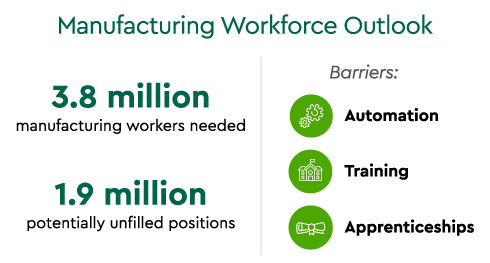
Figure 6
Employers are responding in the following ways:
View PDF of Figure 6 PDF opens in a new window[PDF] footnote PDF video transcript
- Expanded apprenticeships and earn-while-you-learn programs
- Partnerships with community colleges and technical schools
-
Upskilling initiatives focused on automation, maintenance, data and quality
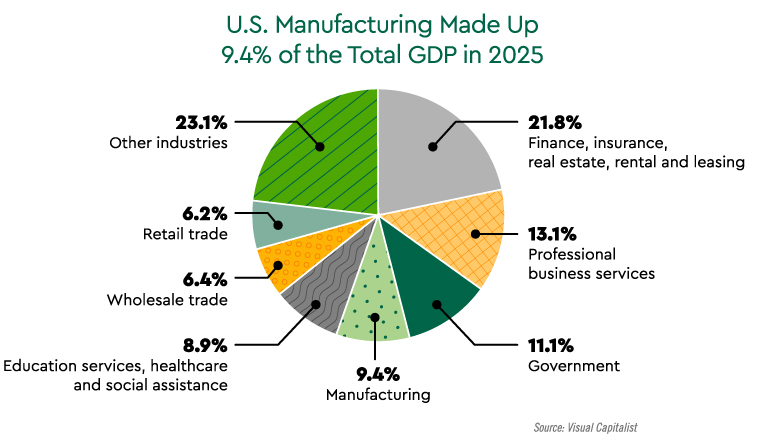
Figure 7
View PDF of Figure 7 PDF opens in a new window[PDF] footnote PDF video transcript
Regional labor conditions continue to influence how manufacturers approach hiring and expansion. In states where technical education systems are well developed and manufacturing activity is concentrated, companies benefit from stronger workforce pipelines and more consistent access to training partners opens in a new window. Community college networks, employer coalitions and targeted state incentives can help manufacturers fill technical roles more quickly and support steadier staffing levels.
Many manufacturers are also expanding internal workforce-development programs to strengthen skills and improve retention. Some companies operate training centers that offer instruction in industrial robotics, programmable controls, mechatronics and quality systems. Others are building career-progression frameworks that combine mentorship, cross-training and credentialing to support long-term employee growth and help teams adapt to new technologies opens in a new windowand production methods.
Even with these investments, manufacturers continue to face gaps between open positions and available workers, especially in technical, maintenance and automation-related roles. To manage this, many companies are accelerating the adoption of automation, predictive maintenance tools and digital production systems. These technologies help stabilize output and reduce unplanned downtime, but they also increase the need for workers with advanced skills. As a result, talent strategy remains a central factor in manufacturing’s ability to sustain growth in the coming years.
-
Orders, inventories and supply chain reset. Census “M3” data on manufacturers’ shipments, inventories and orders opens in a new windowshows that while new orders in some industries have cooled from 2021–2022 highs, order backlogs and inventory strategies remain structurally different from the pre-pandemic era. Many manufacturers continue to balance softer near-term order activity with existing backlogs and longer-term project pipelines.
Many manufacturers have moved from lean “just-in-time” inventory models to more resilient approaches for critical components such as semiconductors, specialty metals and battery materials. Facility construction is part of this redesign: Companies are building plants closer to end markets, major freight corridors and supplier clusters to reduce logistics risk and lead-time volatility.
Regional strength and emerging clusters.
Regional manufacturing patterns opens in a new windowmatter more than ever because new plants, supplier ecosystems and workforce investments tend to cluster. As manufacturers make long-term capital commitments, they increasingly favor regions that combine skilled labor, transportation infrastructure, reliable utilities, supplier networks and supportive business environments. These regional advantages are shaping where new facilities are built and where future manufacturing growth is likely to occur.
A quick look at current investment patterns highlights several continuing trends:
- Traditional manufacturing leaders such as California, Texas, Ohio and Michigan continue to account for a significant share of U.S. manufacturing employment, production and value added while attracting new investments in advanced manufacturing.
- The Midwest and Great Plains (including Indiana, Kansas, Nebraska and Oklahoma) continue expanding machinery, food processing, electrical equipment and logistics-related manufacturing by leveraging central transportation corridors, available industrial sites and established supplier networks.
- The Southeast (particularly Tennessee and the Carolinas) remains one of the nation’s strongest manufacturing growth corridors, supported by investments in automotive, HVAC and electrical equipment, as well as batteries, along with robust technical education systems and workforce partnerships.
- The Southwest and Mountain West (including Arizona, Texas, Utah and Nevada) continue attracting semiconductor fabrication, battery production, aerospace and advanced manufacturing projects that require significant infrastructure, abundant power and large development sites.
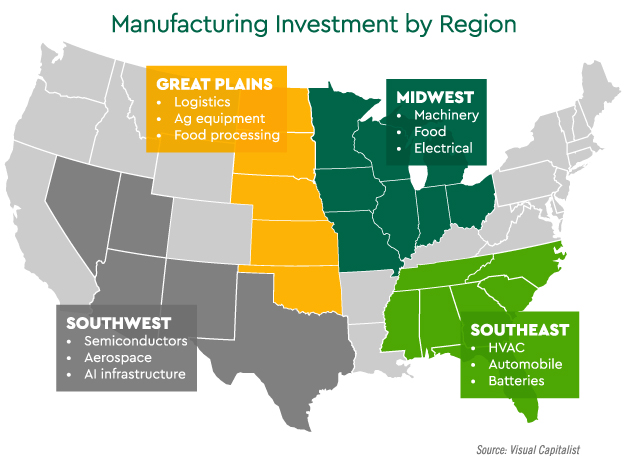
Figure 8
View PDF of Figure 8 PDF opens in a new window[PDF] footnote PDF video transcript
In the Midwest, manufacturing continues to diversify beyond its traditional automotive foundation. States including Indiana, Ohio and Wisconsin have experienced continued investment in machinery, electrical equipment, food processing and logistics infrastructure, reflecting the region’s deep industrial base, skilled workforce and extensive freight network.
The Great Plains — including Kansas, Nebraska and Oklahoma — remain attractive for both traditional manufacturing and emerging industries. Companies continue to cite central geographic location, multimodal transportation access, competitive operating costs and available industrial land as key advantages for new manufacturing and distribution investments. Continued growth in food processing, agricultural equipment and electrical equipment manufacturing reinforces the region’s importance within the national supply chain.
The Southeast continues to be one of the country’s most active regions for manufacturing expansion. Tennessee and the Carolinas remain leaders in automotive components, HVAC equipment, electrical systems and battery-related manufacturing. Strong technical college systems, workforce development initiatives and continued investment in industrial infrastructure have helped position the region as a destination for advanced manufacturing projects.
Meanwhile, Western states such as Arizona, Utah and Nevada continue to benefit from investments in semiconductor manufacturing, aerospace, defense and advanced technology. These projects require large development sites, significant electrical capacity and highly specialized infrastructure, reinforcing the region’s role in the nation’s long-term manufacturing strategy.
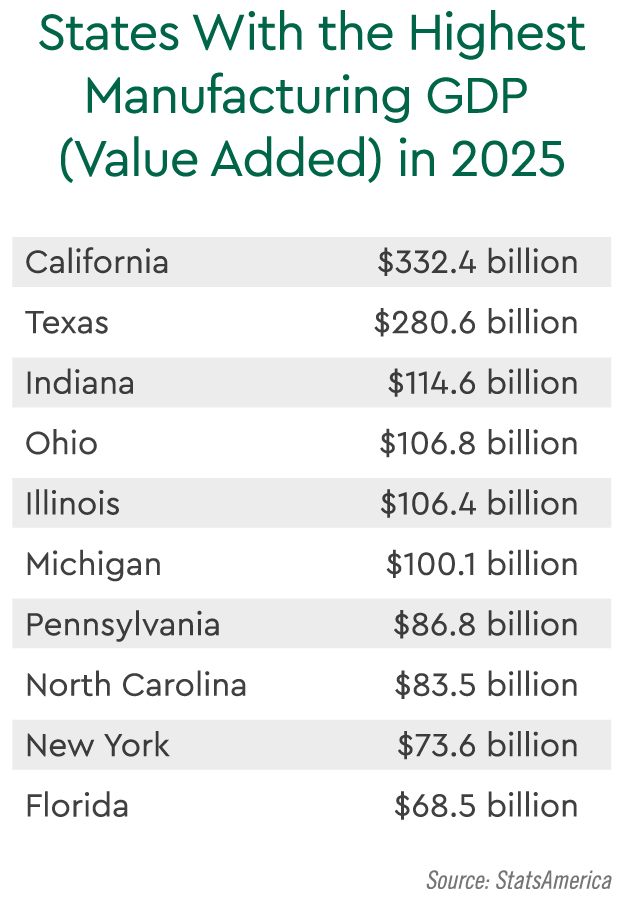
Figure 9
View PDF of Figure 9 PDF opens in a new window[PDF] footnote PDF video transcript
These regional clusters create powerful multiplier effects. As new manufacturers establish operations, suppliers, logistics providers, engineering firms and workforce development, partners often follow, making additional investment increasingly attractive. This ecosystem approach continues to strengthen regional competition while encouraging further manufacturing construction and long-term industrial growth.
Looking ahead: 2026–2027 outlook.
Rather than relying on a single forecast, it’s helpful to consider several possible scenarios for the manufacturing sector over the coming months.
The baseline.
Manufacturing activity is expected to remain stable, with moderate growth supported by continued investment in factories, data centers, electrical infrastructure, logistics facilities and advanced manufacturing technologies. While production growth may remain measured, long-term capital investment is expected to continue shaping the industry’s direction.
The upside.
Stronger business investment, continued infrastructure development and sustained demand for AI-related infrastructure, electrical equipment, semiconductors and industrial automation could accelerate manufacturing activity. Continued expansion in these sectors would support additional facility construction and equipment investment across the broader manufacturing supply chain.
The downside.
Persistent financing costs, slowing consumer demand, or prolonged uncertainty surrounding trade policy could temper investment in some manufacturing segments. However, many large-scale projects already under construction, including semiconductor fabrication, battery manufacturing, electrical equipment production and data-center development, are expected to continue due to their multi-year investment horizons.
Across all three scenarios, several themes appear likely to remain durable:
- Construction-related investment in manufacturing facilities, data centers, cold-storage facilities and advanced production plants continues to support long-term industrial growth.
- Automation and digital technologies are improving productivity while helping manufacturers address labor shortages and increase operational efficiency.
- Workforce development remains a strategic priority as manufacturers invest in apprenticeships, technical training and higher-skilled production roles.
- Regional manufacturing ecosystems continue to attract investment by combining supplier networks, transportation infrastructure, workforce availability and supportive business environments.
- Supply-chain resilience remains a central consideration in facility location, inventory strategy and capital allocation decisions.
The key takeaways.
The first half of 2026 reinforced a trend that has been building for several years: Manufacturers continue making long-term investment decisions amid a complex economic environment. While production, hiring and new orders have fluctuated, investment in facilities, technology and workforce capabilities has remained remarkably consistent.
The evidence throughout this report suggests that U.S. manufacturing is evolving rather than slowing. Companies are investing selectively, prioritizing projects that improve productivity, strengthen supply chain resilience and position operations for long-term competitiveness.
For manufacturers, developers, suppliers and lenders alike, the most important question is no longer simply how much manufacturing output will grow — it’s where manufacturers continue to invest and how those investments will reshape regional economies and industrial supply chains. The facilities under construction today, the technologies being deployed, and the workforce strategies taking shape across the country will help define the next chapter of American manufacturing.
Disclosures:
To view or print a PDF file, Adobe® Reader® 9.5 or above is recommended. Download the latest version opens in a new window.