Weathering uncertainty: Construction's mid-year assessment.
Key takeaways:
- Mid-2026 construction shows mixed signals, with strong data center-driven growth and stable backlog, contrasted by housing declines, rising input costs and weakening contractor confidence amid geopolitical and inflation pressures.
- Severe labor shortages remain construction’s biggest constraint, with the industry needing hundreds of thousands of workers through 2030, driven by retirements, immigration declines and nonresidential demand.
- Rising input and energy costs — driven by tariffs and geopolitical conflict — are squeezing margins and pushing contractors toward risk mitigation strategies, contract adjustments, and tax-driven equipment investment opportunities.
The first six months of 2026 were anything but predictable for contractors in the U.S. construction industry.
On one hand, several signs pointed to continued strengthening of the market. ConstructConnect’s project stress index, which tracks delayed bid dates, on-hold projects, and abandonments in preconstruction, continued its considerable improvement that began in 2025 link opens in a new window, ending May at its lowest level in almost two years. Abandonments — or a lack thereof — were the biggest factor in the decline: The stress indicator was down 14.2% for the month and an impressive 30.2% over the previous 12 months.
In another good sign for the industry, the Associated Builders and Contractors (ABC) backlog indicator, which reflects the work that commercial and industrial contractors expect to have in the months ahead, remained relatively strong link opens in a new window. Despite only modest gains in May, the indicator rose in virtually every category — from type of construction and region to company size — year-over-year.
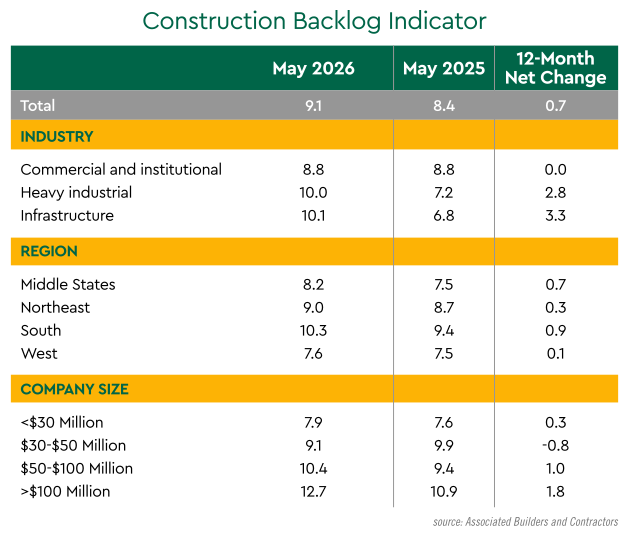
Figure 1
View PDF of Figure 1 PDF opens in a new window[PDF] footnote PDF video transcript
The largest gains came from the seemingly unstoppable data center market, which drove almost as many headlines as it did projects. Pushback against proposed hyperscale data centers like the Stratos Project — which could stretch across 20,000 acres of land near Utah’s Great Salt Lake, when completed — sparked controversy in communities that objected to the structures’ potential environmental impacts. That hasn’t been nearly enough to slow the market, though: Data center construction was up 28% in April, year-over-year, accounting for roughly $50 billion in monthly spending.
The impacts of the data center boom extend far beyond the structures themselves. According to a mid-year report link opens in a new window from accounting firm PricewaterhouseCoopers, data center capacity is expected to triple by 2031, adding nearly 75GW of load and creating historic demand for power generation. As a result, investor-owned utilities have budgeted nearly $1.4 trillion for expanding the grid over the next five years alone, creating tremendous opportunities for construction firms that specialize in power distribution, generation and emerging electrification markets like heat pumps and EV charging infrastructure.
Predictably, that growth in data center construction has also helped to buoy the labor market. Construction industry employment was up nearly 1% link opens in a new window year-over-year in May, with the vast majority of the 68,000 jobs added in that time going to projects in nonresidential construction. The unemployment rate was consistent over that same period, hovering near 4%.
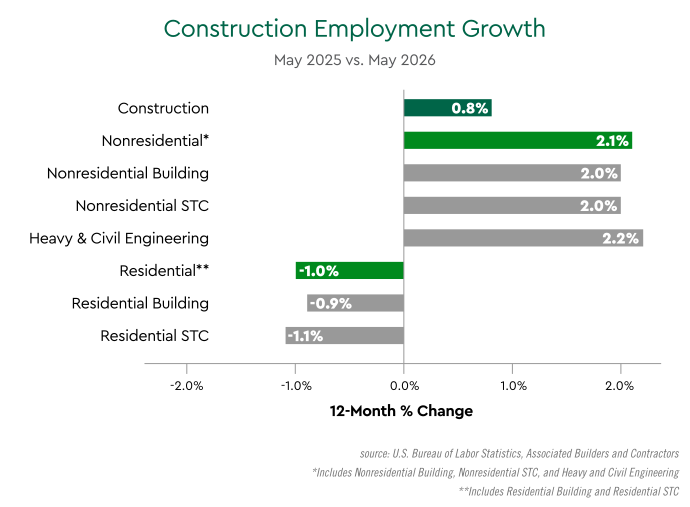
Figure 2
View PDF of Figure 2 PDF opens in a new window[PDF] footnote PDF video transcript
Yet a pervasive sense of apprehension still casts a shadow over those bright points. The ABC Construction Confidence Index dipped in May link opens in a new window, revealing contractors’ concerns about sales, profit margins and staffing. And their concerns weren’t unfounded. For one thing, while demand for data centers was up significantly, those projects still make up less than 7% of the nonresidential construction market. Much like the AI and tech boom that they’re fueling, data centers are threatening to create a lopsided environment, propped up by a limited number of players.
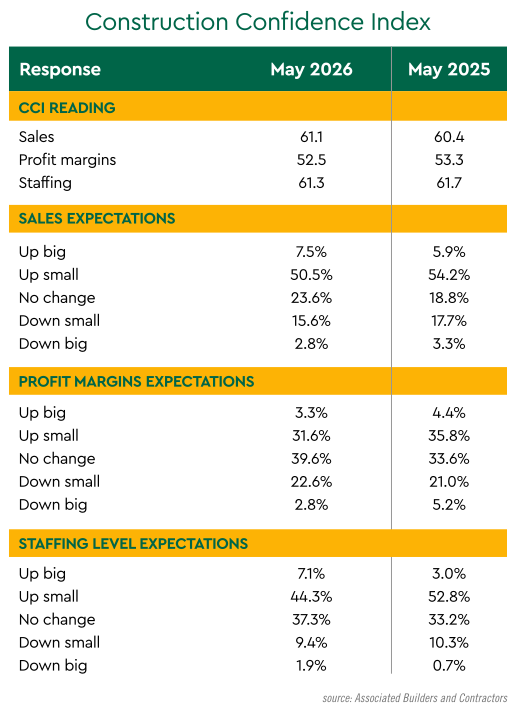
Figure 3
View PDF of Figure 3 PDF opens in a new window[PDF] footnote PDF video transcript
But there were other worrying signs as well: Housing starts and completions were down significantly link opens in a new window month-over-month and year-over-year in May.
Perhaps most troubling was the economic fallout from the war in Iran. Specifically, input prices for new nonresidential construction rose 1.8% in May and 8.4% year-over-year link opens in a new window — the largest increase since the height of the post-COVID price shocks in November 2022, according to producer price index data from the Bureau of Labor Statistics. Energy prices for construction surged link opens in a new window over the year ending May 2026, up nearly 70%. Though no one could have accurately predicted the rapid escalation of tensions in the Middle East, concerns about geopolitical instability were already widespread: Coming into 2026, nearly half of construction firm executives who responded to a survey by Autodesk link opens in a new window classify their supply chains as “fragile due to geopolitical tensions.”
As a result, inflation, which had shown little sign of easing over the previous 12 months, jumped in the second quarter of 2026. The Federal Reserve, under recently confirmed Chairman Kevin Warsh, held interest rates steady in June, though economic forecasters anticipate additional rate pressure later in the year link opens in a new window.
Taken together, those signs all point to continued uncertainty throughout the second half of 2026. However, there are several things that enterprising firms can do to not only weather the current market, but also position themselves to come out the other side even stronger than before.
Labor demand is paramount.
Firms have continued to hire at a steady pace — one reason for cautious optimism — but the ongoing labor shortage is still one of construction’s biggest short- and long-term challenges. Coming into 2026, the ABC Index calculated that the industry needed to attract 349,000 new workers link opens in a new window in one year alone to keep pace with demand for construction services. Another 457,000 will be needed in 2027.
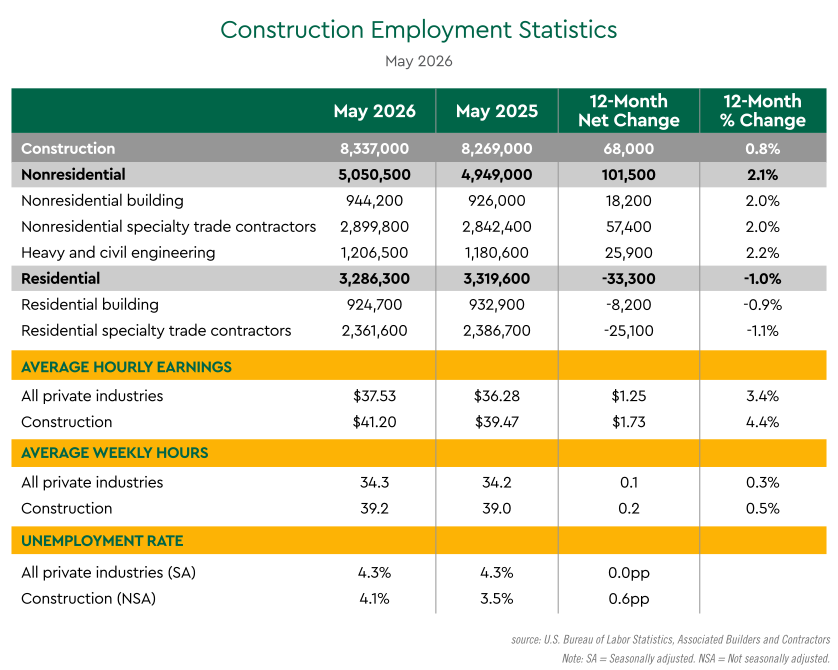
Figure 4
View PDF of Figure 4 PDF opens in a new window[PDF] footnote PDF video transcript
As daunting as those estimates sound, they might be even higher if the ABC ran the numbers again now. “The hiring outlook was pretty bleak at the start of this year, both for construction and the broader economy,” according to Zack Frist, an economist with ABC. “But both have surprised us over the first couple of months of 2026. If we redid the model now, the number would probably be larger.”
It’s important to note that these numbers can be noisy. At the start of 2025, ABC’s model predicted a need for nearly 500,000 new construction workers link opens in a new window in 2026. Regardless, the fact remains that the industry is facing a significant uphill climb to meet the overall demand for labor. And it’s not expected to improve anytime soon. A report released in April link opens in a new window by commercial real estate and property investment firm JLL predicts that by 2030, more than two million trades positions for electricians, HVAC technicians, plumbers, pipefitters, construction equipment operators, general maintenance workers and more could go unfilled.
“We're at a critical inflection point where demand for skilled trades is accelerating while the available workforce continues to shrink,” according to Dr. Paul Morgan, Global COO, Real Estate Management Services at JLL. “We risk operational disruptions that will ripple through the entire economy, affecting everything from construction timelines to energy costs to building safety.”
Though the report goes on to highlight the soaring cost of college tuition and the AI-driven decline in white-collar jobs as reasons to be bullish about the next generation’s interest in the trades, rebuilding that pipeline will take time.
The continued immigration crackdown isn’t helping to improve the labor market’s outlook. Immigrants made up more than 26% of the construction workforce link opens in a new window in 2024 — an all-time high according to the National Association of Homebuilders. That’s the most recent number available for the construction industry, but nationwide data show a precipitous drop in migration: link opens in a new window After peaking in 2024 at 2.7 million, net migration dropped by more than half in 2025, falling to 1.3 million, and the U.S. Census Bureau predicts that number will drop even further in 2026, to just 320,000.
Anecdotal data link opens in a new window suggests a similar decline of immigrant workers within the trades.
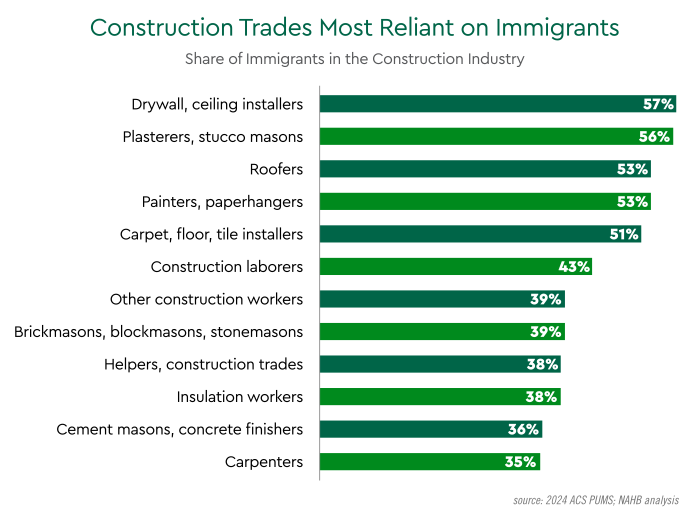
Figure 5
View PDF of Figure 5 PDF opens in a new window[PDF] footnote PDF video transcript
So what can be done? For starters, contracting outfits that can afford to hold onto their workers in between jobs should strongly consider doing so. And it seems that may already be happening. According to ABC’s Frist, fewer construction workers were laid off in April than in any month since early 2022, when the labor shortage peaked. “The fact that contractors are not laying off workers suggests that they are retaining them when they otherwise wouldn't,” Frist says. “Because they know that hiring is so difficult.”
Other contractors are taking a much more proactive approach, going beyond retention to aggressive recruitment link opens in a new window. One large firm based in St. Louis, Mo., has built a year-round internship program that draws from local high schools, technical programs, and universities, introducing young people to the industry before they’re ready to enter the workforce by providing hands-on experience. The company expects to hire nine of its interns in 2026.
ABC is going a step further. In June it announced a partnership with Meta link opens in a new window to launch a training academy specifically for new data center construction technicians. The five-week training is free, no previous experience is required, and all participants are guaranteed a job with a contractor working on a Meta partner data center upon completion of the program. An ABC spokesperson says the organization hopes to add “thousands” of electricians and craft professionals to the labor pool through the America’s Workforce Academy.
Responding to the shortage may also require some creative branding. The JLL report points out that as buildings evolve and incorporate more smart technologies like IoT platforms, automated building management systems, and real-time sensors, the workforce will need to go through a similar evolution. Though at first blush that may seem like an added challenge, “this is a compelling proposition for young, digitally native talent entering the workforce — and a defining opportunity for the industry to rebrand skilled trades as the next-generation, technology-empowered profession it has become.”
Prices soar, but opportunities remain.
Coming into 2026, builders had at least some reason to be optimistic about their finances, in large part due to the easing of interest rates throughout 2025. The industry notched another big win in late February when the U.S. Supreme Court struck down the Trump Administration’s tariffs, which had contributed to a 2.8% increase in construction input prices link opens in a new window over the previous year. The relief was short-lived, though; the administration responded within days by levying a new 10% across-the-board tariff that is set to extend through the middle of the summer.
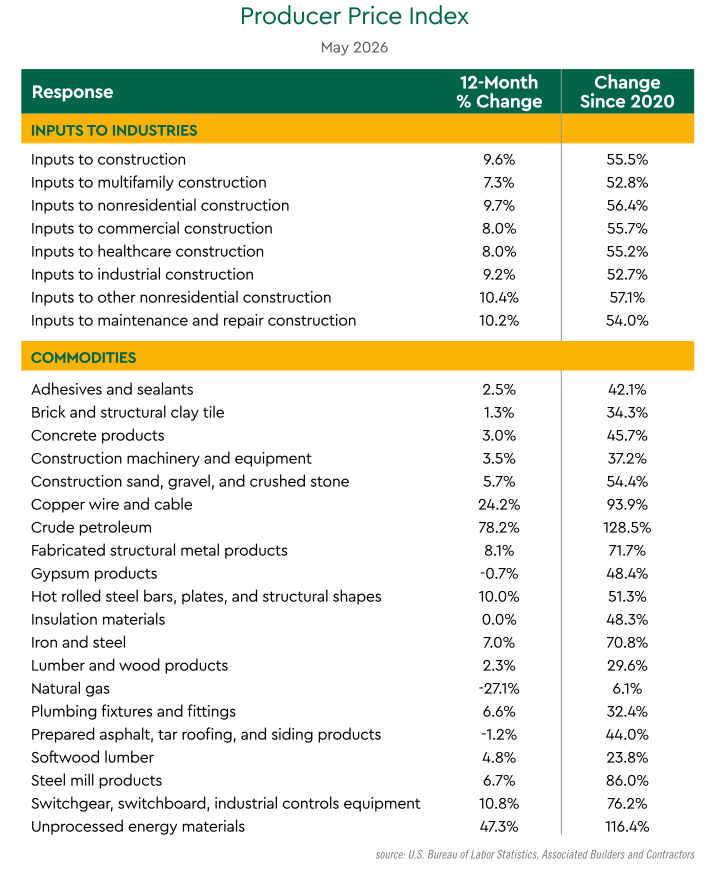
Figure 6
View PDF of Figure 6 PDF opens in a new window[PDF] footnote PDF video transcript
Then, in March, came the unexpected conflict in Iran, which led to the closure of the Strait of Hormuz and a sudden, worldwide oil shortage that sent prices skyrocketing. By May, the price of crude petroleum had jumped more than 78.2% in just 12 months and more than 128% since the start of the COVID-19 pandemic.
Beyond the obvious impacts on fuel prices, the abrupt disruption in petroleum had a cascading effect throughout the industry. The costs of asphalt, PVC and HDPE piping, sealants, the simple act of shipping materials — each threatened to create significant budget pressure.
Macrina Wilkins, Director of Market Insights at the Associated General Contractors of America (AGC), says that despite this scenario, the industry had built up enough scar tissue from the previous six years of market volatility to survive, if not thrive. “To some degree, there is a precedent,” she says. “Contractors had to work through 2025, so they know how to navigate uncertainties. They have some awareness of what to do when the market fluctuates quite quickly based on factors outside of their control.”
One skill that many contractors developed in the early post-COVID years — and that will continue to serve them well now — is looking for as many opportunities to mitigate risk as they can find. In many cases, that starts with the bidding process. Contractors’ bid prices rose 3.5% year-over-year in May link opens in a new window. During that same period, input costs rose 8.4%. “What that tells me right off the bat is that contractors are eating some of the costs,” AGC’s Wilkins says. “Contractors can only absorb those cost changes for so long.”
Wilkins suggests that firms can respond by taking one of two approaches: Those with liquidity can explore being a little more aggressive and proactive by stocking up on inventory ahead of time. Negotiating harder where possible may also be worth considering.
On the other hand, those that aren’t in a position of strength to weather price fluctuations should consider a pause. “Be conservative not just in how you bid, but also in what you bid on,” Wilkins says. “If you can, wait to see how a particular tariff plays out, or for a resolution to a geopolitical event.”
And for firms that have been considering dipping their toes into a new market — and have the financial wherewithal — this may be the perfect opportunity to pivot. With data center demand rising faster than the construction industry can keep up and other markets like healthcare and power expanding as well, adaptable contractors could find themselves in a position to take full advantage of the moment.
Here are some other potential strategies for adapting to the current fiscal moment:
- Consider price-escalation clauses or cost-plus contracts. Price fluctuations — especially during these highly volatile times — simply can’t be predicted. Structuring contracts to ensure you’re not forced to shoulder the full burden of those increases is imperative. And subcontractors should exercise caution when considering “paid when paid” contracts.
- Stay on top of billing. Payment delays continue to plague the construction industry, at each step in the invoicing chain. Punctual billing and notification of cost increases can’t solve everything, but they are proactive steps that offer a level of control in an otherwise unpredictable process.
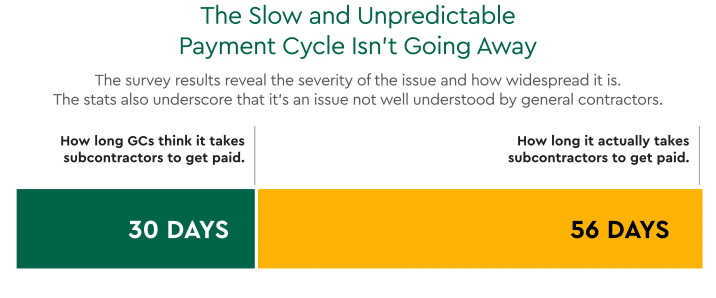
Figure 7
View PDF of Figure 7 PDF opens in a new window[PDF] footnote PDF video transcript - Update your contracts. Boilerplate contracts are only useful as long as conditions remain unchanged. Make a point of revisiting them regularly to identify and update provisions that could be putting you at a financial disadvantage.
Above all, AGC’s Wilkins stresses that contractors should lean on the core competencies that have allowed them to succeed in previous challenging stretches: “It’s safe to say those strategies would serve you well moving forward because they're based on limiting uncertainty and mitigating risk.”
Equipment gets efficient and flexible.
Amidst all the other economic upheaval, contractors have had one cause for celebration: The 2025 federal tax and spending bill introduced significant new opportunities for equipment financing. For starters, businesses can now expense $2.5 million — doubling the previous limit of $1.25 million — with the phase-out threshold rising to $4 million. This expansion means significantly more businesses can take immediate deductions on equipment purchases.
Perhaps most consequential, though, is the return of 100% bonus depreciation. For small to medium-sized contractors, this change could have major implications for their capital planning, tax strategy and long-term investment decisions by allowing them to immediately deduct the full cost of eligible equipment.
Bonus depreciation then and now.
Tax benefits for the purchase of a $50,000 piece of equipment, before and after changes to the tax code.
Previous tax rules:- Year 1 depreciation: ~$7,000–10,000
- Remaining depreciated over 5–7 years
- Limited immediate tax benefit
- Immediate deduction: $50,000
- First-year tax savings: $12,000–15,000+
- Net equipment cost: $35,000–38,000 after tax benefits
Source: ElmBlue Equipment Finance.
The change comes at an opportune time, when construction equipment is evolving in exciting ways and offering contractors cost-, time-, and even lifesaving capabilities. As oil prices continue to fluctuate — and certainly show no sign of dropping to pre-COVID levels — demand for more fuel-efficient equipment is likely to stay elevated. And manufacturers are responding by developing technologies such as multi-fuel or fuel-agnostic engines that offer more flexibility to respond to economic and jobsite conditions.
As the name suggests, multi-fuel engines can be converted to run on a variety of fuel types. These highly versatile engines are built on a common base architecture, and cylinder heads and other components can be swapped out to run on diesel, natural gas or hydrogen. That capability allows contractors to not only adapt to market forces like the cost of fuel. It also helps to future-proof their fleets against regulatory changes that may arise down the line.
Next-generation technologies are doing more than simply improving fuel efficiency, though. They’re also reshaping the jobsite altogether. As in other markets that are rushing to take advantage of the AI boom, the construction industry is welcoming the technology with open arms — and tech firms are all too happy to oblige. Earlier this year, Bedrock Robotics raised a whopping $270 million in investor funding for its autonomous equipment retrofitting system.
Though the company’s technology is still in the development phase, it’s building toward a day when existing heavy machinery could be equipped with GPS, motion sensors, and a distance-detecting technology called LiDAR, and operate on its own.
In the short term, firms are leveraging AI to improve jobsite safety. The construction industry accounted for 1,032 workplace fatalities in 2024 link opens in a new window, the most recent year for which data is available. And while that’s an improvement over the previous year, it’s still the second-highest number among occupations that the Bureau of Labor Statistics tracks.
Among new equipment options available for helping to mitigate the risk of workplace injuries and deaths are AI-enabled devices like cameras, drones and predictive analytics.
Equipped with algorithms that are trained on massive amounts of data, these tools can monitor the jobsite for safety violations that could lead to accidents; scan and analyze sites for potential hazards; and predict when and where accidents are most likely to occur, respectively.
Given the ongoing market volatility — and lack of clarity about what the immediate future holds — holding off on major equipment investments may be the best strategy for many contractors. However, for those with cash on hand, the next six months could provide a real opportunity to take advantage of new tax incentives and rapidly evolving technology to separate themselves from their peers.
The road ahead.
The first half of 2026 was marked by a series of uncertainties within the construction industry, some expected and many others not. And though that environment has made forecasting more challenging than ever, contractors and builders are hardly strangers to ambiguity. They are resilient by nature, and the last decade has forced them to develop even more skills for mitigating risk and anticipating — and leveraging — opportunities.
A strategy of sticking to core competencies, while pivoting to new markets when possible, will continue to serve firms well for the foreseeable future. Above all else, though, the investment with the highest potential for return will be in labor. Retention, through competitive wages and a labor-friendly work environment, is important in the short term. But recruitment will be critical for the months and years ahead.
“Demand for labor is going to continue to remain strong through the remainder of the year,” says Zack Frist of ABC. Firms that put themselves in a position to weather labor shortages if they intensify will be best equipped to respond.