Dental industry trends: The economics shaping practice ownership.
Key takeaways:
- Dental practices are facing a “fiscal squeeze” with rising costs, stagnant reimbursement rates, and competitive pressures from consolidation, yet long-term growth remains strong as consumer demand and untapped patient populations expand the market.
- Strong financial performance depends less on revenue growth and more on cash flow discipline, including fee schedule adjustments, efficient collections, AR management, and automation to reduce billing friction and improve liquidity timing.
- Technology, financing strategy, and risk controls are increasingly critical, with AI and equipment investments requiring clear ROI evaluation, while cybersecurity threats and fraud risks make strong internal controls and banking partnerships essential.
You trained for years to master the clinical side of dentistry, but running your practice also means navigating cash flow management, insurance negotiations, equipment investments and other business decisions.
There are additional challenges involved with practice ownership today, including stagnant reimbursement rates, rising equipment costs and the introduction of AI, which is moving faster than most practices can keep up with. In addition, a wave of private equity consolidation is reshaping the dental industry’s competitive landscape.
In this guide, you’ll learn about the key financial challenges and opportunities facing dental practice owners today, and what you can do to help build and sustain a successful practice.
The state of the dental industry: Growth, pressure and opportunity.
According to the American Dental Association’s Health Policy Institute (HPI), the dental industry is experiencing a “fiscal squeeze. opens in a new window ” Expenses are rising faster than revenue, reimbursement rates lag behind inflation and the operational demands on practice owners continue to grow. Prices for dental equipment and supplies rose 5% in 2025 opens in a new window , driven mainly by tariff pressures on imported materials.
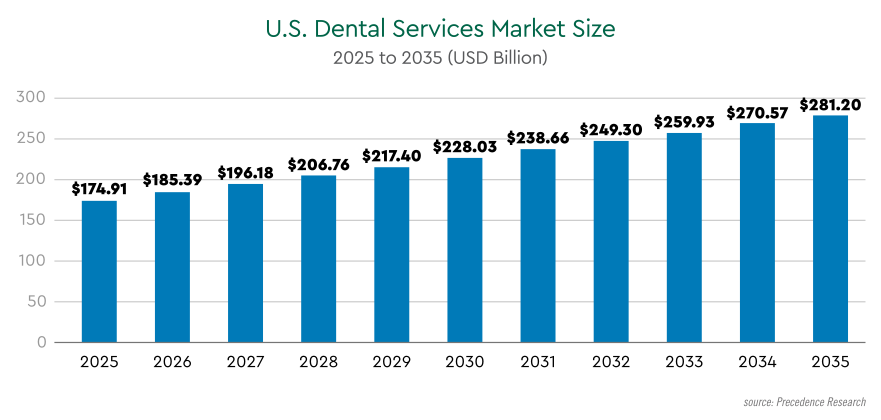
Figure 1
View PDF of Figure 1 opens in a new window[PDF] footnote PDF video transcript
Economic confidence among dentists in 2025, while stable, sits considerably lower than it did the previous year, with 82.7% of dentists expressing lower confidence, pointing to tariff pressures and rising costs opens in a new window as the primary reasons.
And yet the long-term fundamentals of the dental industry remain strong. Consumer dental spending grew opens in a new window 4% in 2025 and sits 9% above pre-pandemic levels. The U.S. dental market is projected to grow at a compound annual growth rate of 4.86% between 2026 and 2035 opens in a new window .
The ADA’s chief economist opens in a new window has pointed to a significant long-term opportunity: Roughly half of the U.S. population remains disengaged from the oral health system. As awareness of the connection between oral and systemic health grows, the addressable market for well-run practices is vast. The chief economist predicted a future “golden era” for oral health.
Managing costs without sacrificing care.
For many dental practices, payroll alone can consume 30% to 40% of gross revenue, and with clinical hiring markets tight, wage pressure shows no sign of easing. That means it’s especially important to carefully manage the non-payroll portion of the ledger. Even practices generating strong revenue can find themselves short on cash in a given month if collections, payment timing and accounts payable (AP) aren’t working in sync.
Cash flow management, not revenue generation, is the area in which many financially stressed dental practices struggle. A dental practice can be highly productive and still face a liquidity crunch if money is moving out faster than it’s coming in or arriving too slowly. These are the levers that are most worth pulling:
- Review your fee schedule annually: A modest annual fee increase could keep your pricing competitive and support your practice’s financial needs. Large, infrequent catch-up increases tend to generate patient pushback while small, consistent ones rarely do.
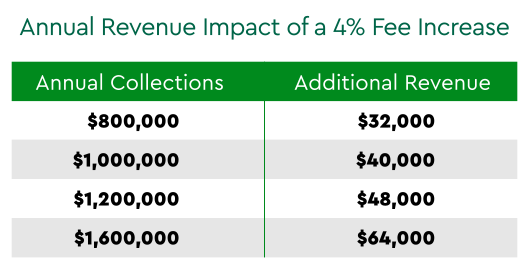
Figure 2
View PDF of Figure 2 opens in a new window[PDF] footnote PDF video transcript - Tighten your collections process: Unresolved patient balances are among the most common and avoidable drains on practice cash flow. Clear payment policies communicated upfront, multiple payment channels and consistent follow-up protocols can all help accelerate the time between service delivery and full payment.
- Make your revenue cycle more efficient: Fully automating the billing process to include electronic eligibility verification and automated claims submission helps reduce manual work and the rework that comes with errors. This frees up staff time and helps compress the payment cycle.
- Actively monitor your accounts receivable (AR): Staying on top of AR can help prevent small balances from becoming big problems. Give your front office a simple script for calling patients at 30 days overdue, and make it a habit to flag outstanding balances before any appointment so you can collect when patients arrive.
- Train your employees: Your staff can play a key role in driving revenue by clearly communicating to patients the “why” behind their treatment plans, so they’re more likely to follow through with them.
- Use a line of credit strategically: Access to working capital is most valuable when secured in advance, rather than during a shortfall. A revolving line of credit gives you a buffer against timing mismatches without disrupting your operating account.
Technology and AI: How to evaluate ROI before you invest.
Artificial intelligence has moved from the margins of dentistry into the mainstream faster than almost anyone anticipated. Here are a few AI applications that you may want to consider:
- Diagnostic imaging analysis: AI-assisted detection of caries, bone loss and pathology on X-rays and CBCTs can improve both diagnostic accuracy and the documentation that supports treatment plan acceptance.
- Treatment plan acceptance tools: Visual tools that help patients understand the consequence of inaction are some of the most direct revenue levers available to any practice.
- Scheduling and recall automation: Intelligent recall systems cut down on no-shows, optimize chair time and improve hygiene retention rates.
- Billing and coding optimization: AI-assisted coding tools can reduce claim denials and help speed up the reimbursement cycle.
Cloud-based AI diagnostic tools for many small to mid-size dental practices typically run $200 to $900 per month opens in a new window , with most practices that track outcomes reporting positive ROI within six to 12 months opens in a new window . Larger capital investments require more rigorous analysis. For example, when considering the purchase of a CBCT machine (which can cost $50,000 to $100,000 opens in a new window for a new system) or a chairside CAD/CAM system ($60,000 to $100,000 or more) opens in a new window , these significant capital commitments should be evaluated against projected throughput gains and case acceptance improvements rather than just clinical benefits.
Financing these investments through equipment loans rather than working capital can help preserve cash flow and match the repayment timeline to the useful life of the asset. If you’re considering an AI equipment or software purchase, ask yourself a few simple questions:
- Does it address a bottleneck I experience several times a week?
- Can I measure its impact within 90 days?
- Can I carry the monthly cost without putting pressure on my operating cash flow?
An AI technology that doesn’t clearly improve efficiency, patient experience or profitability may be more of a “nice to have” than a smart business investment.
Financing strategies for equipment, expansion and acquisitions.
Whether it’s adding a new operatory, purchasing a CBCT machine or stepping into full ownership, every significant financial decision that your dental practice makes comes down to the same fundamental question: Does the investment generate enough return to justify the cost and the risk?
Buying or leasing equipment
Before you commit to any major equipment purchase, consider these two questions:
- What clinical or operational problem does this equipment solve, and how often does that problem affect the practice?
- How long will it realistically take before the investment pays for itself in additional revenue or reduced costs?
Many equipment purchases require months of patient education, new appointment types and process changes before they start contributing meaningfully to the bottom line. Building that lag into your cash flow projections, rather than assuming immediate return, can lead to better financing decisions.
However, equipment needs rarely announce themselves conveniently. Getting preapproved for a financing line before you’re actively searching gives you far more flexibility than scrambling for capital after you’ve already identified what you want. Equipment financing can help keep your business accounts available to cover planned expenses and your lines of credit available for other unexpected short-term expenses.
The loan-versus-lease decision deserves careful thought as well. Leasing tends to lower the monthly cash outlay, preserves flexibility if the technology evolves quickly, and may offer favorable tax treatment depending on your practice’s structure. Purchasing builds equity in the asset and typically costs less over the full useful life of the equipment. The right answer depends on your cash position, tax situation and how long you expect to use the equipment.
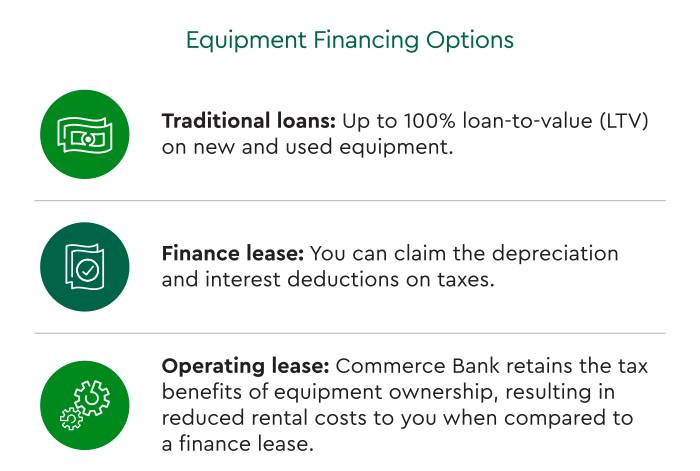
Figure 3
View PDF of Figure 3 opens in a new window[PDF] footnote PDF video transcript
Buying into a practice.
A dental practice buy-in — where you purchase partial or complete ownership of an existing practice — has become one of the most common paths into ownership, particularly for dentists who are managing significant student debt and aren’t yet positioned to start or acquire a practice outright.
A buy-in offers several meaningful advantages. You can step into an existing patient base and revenue stream, and you can share overhead and administrative costs with an established team. You can also grow into full ownership over time rather than carry the full financial weight from day one.
The financing options for a buy-in differ from those for an outright acquisition. Conventional bank loans tailored to dental practice buy-ins can cover partial or full ownership transfers, often with terms that reflect the practice’s existing cash flow rather than requiring substantial personal collateral. Seller financing, where the current owner carries a portion of the purchase price, is a common complement to bank financing and can provide flexibility that conventional loans alone don’t offer. A U.S. Small Business Administration (SBA) loan is also worth considering for its longer repayment terms and lower equity requirements.
The financial health of the practice you’re entering deserves the same scrutiny as any other investment. Collection rates, expense ratios, payer mix, patient retention trends and the stability of the existing provider team are all factors that will directly affect your ability to service debt and generate income after closing. A qualified lender or advisor can help you evaluate whether what you’re being offered is priced fairly, structure financing that aligns with your goals, and helps you to succeed from the first day of ownership.
The dental practices that execute these buy-ins most successfully are usually the ones that planned for them in advance. Whether that means securing equipment preapproval before an urgent need arises, or beginning acquisition conversations with a lender 12 to 18 months before you’re ready to act, early preparation can lead to better terms, less stress and more options.
Protecting your practice: Risk management, fraud mitigation and financial controls.
Healthcare cybersecurity breaches more than doubled from 2024 to 2025 opens in a new window , driven by ransomware, credential theft and third-party vulnerabilities. Dental practices are high-value targets because they hold patient health and financial information as well as insurance and billing data, often with an IT infrastructure that hasn’t kept pace with the sophistication of modern threats.
Common threats to dental practices.
These are three attack vectors that commonly affect dental offices:
- Ransomware: A type of malicious software, ransomware attacks encrypt practice management systems and halt operations entirely. Recovery costs, which include downtime, forensic investigation, data restoration and potential HIPAA regulatory settlements, can be financially catastrophic for dental practices, depending on the scope of the attack. Defense requires current software patching, endpoint detection software and tested off-site backups that are isolated from the primary network.
- Phishing: Email-based attacks are a common entry point opens in a new window for dental office data breaches, driven largely by credential theft and social engineering schemes. Staff training, email filtering and multi-factor authentication on all accounts are the minimum baseline of protection.
- Business email compromise (BEC): BEC scams involve criminals impersonating a vendor, colleague or the practice owner to request a fraudulent wire transfer. A single successful attempt can result in significant financial losses, and recovery is rarely possible once funds have moved.
Risk management recommendations.
Strong internal financial controls deserve equal attention. Here are a few effective internal controls for fraud mitigation that are structural in nature rather than procedural:
- Separate the duties of receiving payments, recording transactions and reconciling accounts. No single employee should control all three steps.
- Require dual authorization on wire transfers and any transaction above a defined threshold.
- Reconcile your bank statements against practice management software monthly, and have it done by someone other than the person processing payments.
- Use bank-level controls. Near-real-time account alerts and tiered online banking access permissions are helpful tools for fraud mitigation. Switching from manual to digital AP systems allows for better segregation of duties and fewer single-person controls over AP tasks.
Keep in mind that HIPAA compliance and cybersecurity aren’t the same thing. A practice can satisfy regulatory requirements while remaining genuinely vulnerable to a breach or financial fraud. Cyber insurance, which now typically requires documented incident response procedures and active monitoring controls, has become an important part of any comprehensive risk management strategy.
DSO consolidation and the independent practice question.
One of the biggest trends in modern dentistry has been the rise of dental support organizations (DSOs), which are corporate entities that contract with one or more dental practices to deliver shared administrative services. DSOs present practice owners with both a real competitive challenge, and for those who understand the dynamics, a genuine financial opportunity.
As of mid-2025, approximately 130 private equity-backed DSOs opens in a new window operate across the dental landscape, more than in any other healthcare vertical. Overall dentist practice ownership in the U.S. has declined from 84.7% in 2005 to 72.5% in 2023 opens in a new window . Dentists with fewer than 10 years of experience are now more likely to be affiliated with a DSO than to own their own practice, which would have seemed unlikely a generation ago.
The forces behind this trend include increased administrative complexity, technology costs, recruiting pressure and the sheer burden of managing a small business alongside a clinical career. For many dentists, DSO affiliation is a rational response to a genuinely difficult operating environment.
For practice owners approaching a transition, the consolidation wave has created meaningful exit opportunities. If your practice has consistent profitability, a diversified payer mix and a strong hygiene program, DSO buyers may be willing to pay a significant multiple of your earnings before interest, taxes, depreciation, and amortization (EBITDA) to acquire it. That represents a significant wealth-building outcome for dentists who have managed their practices with financial discipline.
For dentists who are committed to independence, the lesson is the same: operational efficiency, strategic technology investment, and a strong banking relationship are what separate practices that thrive in this environment from those that feel perpetually squeezed by it.
Building financial resilience: What lenders look for in a dental practice.
Whether you’re seeking your first loan for your practice, refinancing existing debt or planning for an eventual sale or transition, understanding how lenders evaluate dental practices gives you a meaningful advantage.
The framework lenders use is more predictable than most borrowers realize. A dental practice loan decision generally comes down to two things: the financial strength of the practice itself, and your personal financial profile. Both are evaluated, and both can be strengthened with advance preparation.
On the practice side, these are several of the factors that lenders focus on:
- Debt-Service Coverage Ratio (DSCR): This is an important metric in any practice loan underwriting. A DSCR of 1.25x or higher opens in a new window
— meaning the practice generates 25% more cash flow than is needed to cover all debt payments and operating costs — is the typical threshold for favorable lending terms.
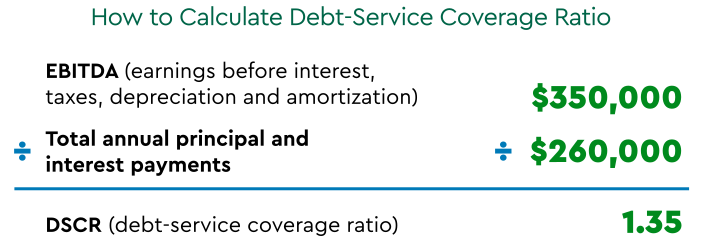
Figure 4
View PDF of Figure 4 opens in a new window[PDF] footnote PDF video transcript - Revenue trend: Three years opens in a new window of consistent or growing collections signals stability. If collections have declined, be prepared to explain why — and what’s changed.
- Payer mix: Heavy concentration in a single insurance plan, or significant Medicaid exposure without offsetting fee-for-service revenue, is treated as a concentration risk opens in a new window . A diversified mix across payer types is viewed positively.
- Hygiene program strength: Recall rates and hygiene revenue as a share of total collections are watched closely. A strong hygiene program opens in a new window produces recurring, predictable revenue, which directly supports DSCR and is one of the clearest indicators of a healthy, well-managed practice.
- Provider concentration: A practice where a single provider generates the overwhelming majority of revenue is more vulnerable to disruption. Multi-provider practices, or those with a documented associate development plan, are considered lower risk.
On the personal side, a credit score above 680 is generally the floor for conventional dental practice lending, with scores above 700 qualifying for better rates. Carrying significant dental school debt doesn’t have to be a deal-breaker. What matters most is whether total debt service remains manageable when all obligations are factored in.
A strong loan application typically includes two to three years of profit-and-loss statements, balance sheets and tax returns; a current cash flow projection; and a clear explanation of how you plan to use the funds and what outcomes you expect. The more organized and transparent your package, the smoother the process tends to go.
One of the most valuable things you can do is start the conversation with your banker well before you need capital. A relationship that’s built over time, in which your banker understands your practice’s growth trajectory and your personal financial goals, can put you in a fundamentally stronger position than walking in cold when you’re already under pressure.
Build your financial foundation with Commerce Bank.
Commerce Bank’s dental banking specialists work alongside practice owners at every stage — from first acquisition to long-term expansion. With deep experience in dental practice financing and solutions designed around how dental practices actually work, we offer more than just a loan. We offer financial insight from someone who understands your industry.
Disclosures:
To view or print a PDF file, Acrobat® Reader® 9.5 or above is recommended. Download the latest version opens in a new window.
To send an email that contains confidential information, please visit the Secure Message Center where there are additional instructions about whether to use Secure Email or Online Banking messaging.